
Trading Earnings Volatility: A Professional Trader's Risk Framework
Trading earnings volatility is one of the few situations where the risk announces itself in advance. Four times a year, a company compresses a quarter of business results into a single release and hands it to a market that has spent weeks guessing. You know the date, you know roughly how large the move could be, and you know that nearly all of it will resolve in a single session.
That combination attracts traders. It also produces a disproportionate share of catastrophic single-trade losses, because the predictability that makes earnings appealing hides how the risk behaves.
Doing it profitably is less about forecasting the print and more about building a risk framework that survives being wrong. Here is how professional desks structure that.
Earnings Are a Volatility Event, Not a Directional Bet
The first framing error is treating an earnings trade as a view on the company. Most traders who lose money on earnings were not wrong about the business — plenty of them correctly predicted a strong quarter and still lost.
An earnings move is the difference between reported results and what the market had already priced in, filtered through forward guidance, positioning, and sentiment. A company can beat on revenue and earnings per share, guide slightly soft, and drop double digits. Another can miss outright and rally because the miss was smaller than feared and management sounded credible on the call.
The honest starting point is that a correct fundamental read gives you far less edge than it feels like it should. Every piece of the framework below follows from accepting that.
Understand What Implied Volatility Is Telling You
Options going into earnings carry elevated implied volatility reflecting the market's estimate of the coming move. You can extract an approximate expected move from that pricing — a rough shorthand is the combined cost of the at-the-money call and put in the nearest expiration after the report.
That number is not a prediction. It is a market-implied one-standard-deviation range, which means the stock finishes outside it a meaningful share of the time. Treating it as a ceiling is a common way traders end up under-hedged.
The more important mechanic is what happens after. The uncertainty that inflated those prices disappears the moment the numbers are public, and implied volatility collapses — often severely — in the first minutes of the next session. This is IV crush, and it is why an option buyer can be directionally right and still lose money: the stock moved, but not far enough to offset the premium that evaporated underneath the position.
The implication cuts both ways. Long options into a print require a move larger than the market already expects, not merely a move in the right direction. Short volatility structures collect that premium but carry the tail exposure — and earnings tails arrive at the open, past any stop you placed.
Step One: Size to the Gap, Not to the Stop
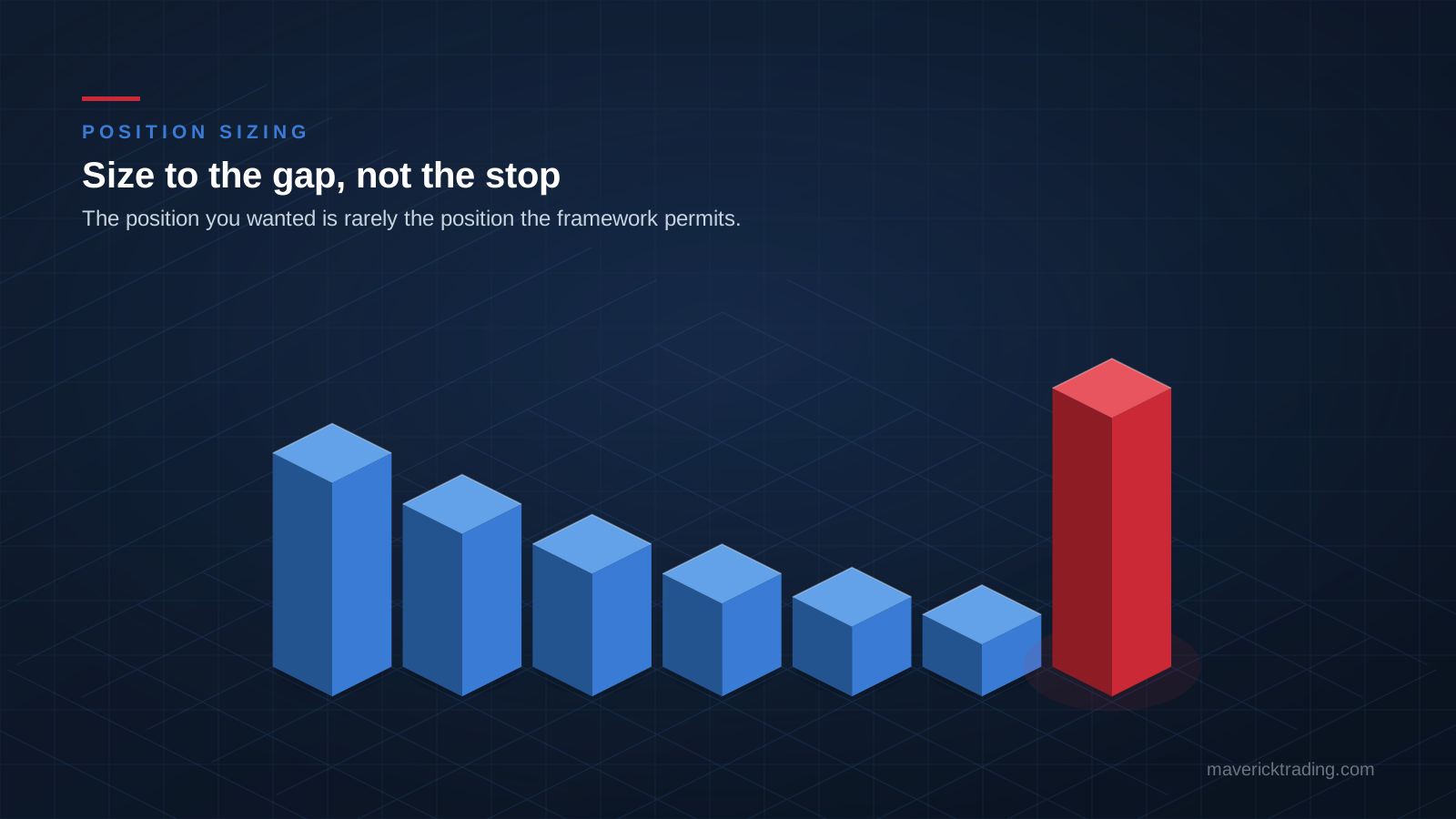
This is the single most important adjustment, and it is where most retail earnings risk goes wrong.
Normal position sizing assumes you can exit near your predetermined level. That assumption is void across an earnings release. The event happens outside regular hours, price reopens wherever the auction clears, and a stop resting three percent below entry can fill twelve percent lower with no intervening prints.
The professional adjustment: size the position so that the full expected move against you — not your stop distance — remains inside your risk limit. If the options market implies an eight percent move and your maximum acceptable loss on any single idea is one percent of capital, the position cannot exceed roughly one-eighth of what you would normally allocate to a trade with a working stop.
This calculation is unforgiving, and it should be. It usually reveals that the position a trader wanted to take was three to five times larger than the risk framework permits.
Step Two: Decide Your Exposure Before the Print, in Writing
An earnings trade has exactly one decision point that matters, and it is before the release. Everything after is execution.
So the plan gets written while you are calm: maximum loss in dollars, the structure used, the reason the trade exists, the condition that invalidates the thesis, and what you will do at the open across three scenarios — gap in your favor, gap against you, and the muted reaction that leaves you holding a position with no volatility premium left. That third scenario is the one traders skip, and the most common outcome.
The moments after an earnings gap are the worst conditions imaginable for judgment: spreads are wide, information is incomplete, the position is already at an extreme, and the pressure to react is intense. Structured desks remove that decision from the moment entirely, which is a core part of how firms manage risk at scale — the framework exists specifically so nobody is improvising while money is moving.
Step Three: Match the Structure to the Actual Thesis
Different views on an earnings event call for different instruments, and mismatching them is a quiet source of losses.
If the thesis is that the move will exceed what is priced, long premium makes sense — but it needs the move to clear both the strike and the volatility collapse. If the thesis is that the reaction will be smaller than expected, defined-risk structures such as spreads or iron condors express that without an open-ended tail. If the thesis is directional, a debit spread caps the volatility exposure that would otherwise work against a long option.
One structure warrants a warning: undefined-risk short volatility into a print. Selling naked options collects premium reliably and works most of the time, which is exactly the problem — small wins accumulate until a single gap erases quarters of gains. If the loss on a position cannot be stated as a fixed number before the release, it does not belong in an earnings framework.
Step Four: Manage the Session After
The initial gap is not the end of the move. Post-earnings drift is well documented, and the session after a report often retraces or extends the opening reaction, catching traders who assumed the event ended at 9:31.
Two rules do most of the work. First, avoid acting into the opening auction, when spreads are widest and price discovery is least reliable — a short defined window to let the market find a level prevents a great many bad fills. Second, if the reason for the trade has been answered, close it. A position held past the resolution of its own thesis is no longer an earnings trade; it is an unplanned directional position that happens to be sitting in the account.
Portfolio-Level Earnings Risk
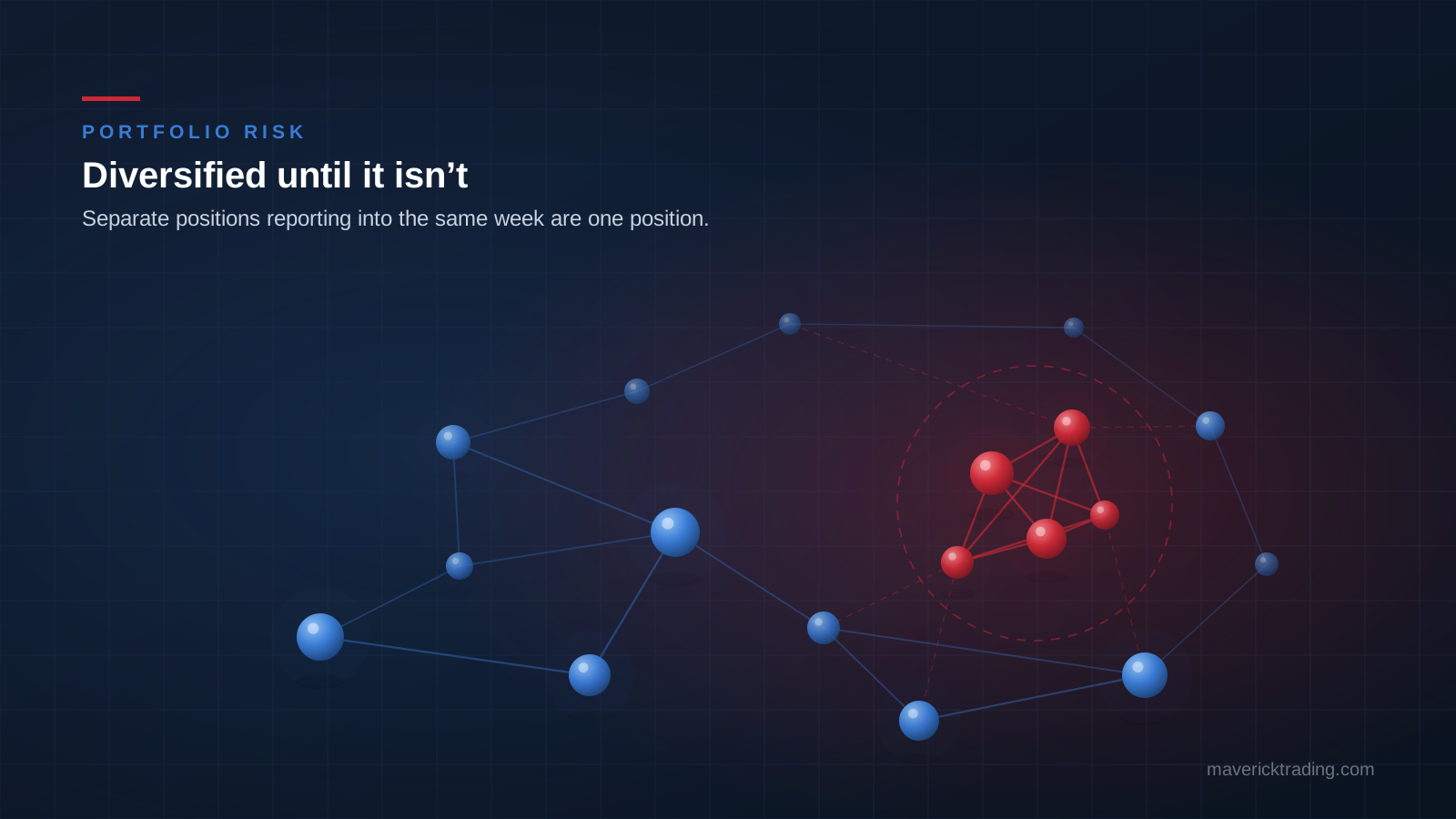
Individual position sizing is necessary but not sufficient. Earnings season concentrates dozens of these events into a few weeks, and risk stacks in ways that are easy to miss.
Three exposures deserve explicit limits. Sector clustering: five separately sized positions across one industry reporting in the same week is functionally one large bet on a sector theme. Sequencing: a bellwether reporting early sets the tone for peers, so an early miss can reprice names you are holding into their own prints. Aggregate exposure: total capital at risk across all open earnings positions needs a cap, independent of whether each one passes its sizing test.
This portfolio view is also where trader psychology intersects with the numbers. A trader who takes a hard loss on a Tuesday print and sizes up into a Thursday one has left the framework entirely, regardless of what the position sizing spreadsheet says. Emotional control in trading is the mechanism that keeps written rules operative under exactly that pressure.
The Rules Worth Writing Down
- Size to the full implied move against you, never to your stop distance.
- Cap total capital at risk across all concurrent earnings positions, not just each one individually.
- Never carry undefined risk through a scheduled event.
- Write the three-scenario plan before the release, and execute it without revision.
- Account for IV crush explicitly in any long premium position.
- Wait out the opening auction before acting on the gap.
- Log the thesis and the outcome separately — being right for the wrong reason is a losing habit that pays.
Final Thoughts on Trading Earnings Volatility
Earnings volatility rewards traders who treat it as a risk management exercise and punishes those who treat it as a forecasting contest. The event is binary, the timing is outside your control, and the outcomes have fat tails that no amount of research eliminates.
What is inside your control is size, structure, and the decisions you make before the market can pressure you. Traders who build a framework around those three things can trade earnings season repeatedly without any single print threatening their capital base. Traders who skip it are making a leveraged bet on a coin flip and calling it analysis.
The difference shows up over a career, not over a quarter.
Working inside a defined risk framework is considerably easier with firm capital, professional oversight, and an incentive structure aligned with your results rather than your entry fee. If you want to see what a real trading career looks like, Maverick Trading's application process is the place to start.