
How Fed Speeches Move Currency Markets: A Trader's Guide to Jackson Hole
Every August, a single speech can undo weeks of technical analysis in a matter of seconds. That is the reality of Fed speech currency market impact, and nowhere is it more visible than at the Jackson Hole Economic Symposium. For currency traders, understanding how to read a Fed Chair's words, and how to position around them, is one of the highest-leverage skills you can develop.
"That is the reality of Fed speech currency market impact, and nowhere is it more visible than at the Jackson Hole Economic Symposium."
This guide breaks down why Jackson Hole matters so much to the forex market, the specific language signals that tend to move the dollar, and the trading strategies that professional traders use to manage one of the most volatile events on the calendar.
Unlike a scheduled data release, a Fed speech does not come with a number you can plug into a model ahead of time. The market has to interpret tone, word choice, and emphasis in real time, and algorithmic systems are built to parse that language within milliseconds of it being spoken. That combination of ambiguity and speed is exactly what makes currency pairs like EUR/USD, USD/JPY, and GBP/USD so prone to sharp, sudden moves during these events.
Why Jackson Hole Drives Fed Speech Currency Market Impact
Every August, the world's most powerful central bankers gather in Jackson Hole, Wyoming. What they say, and how they say it, can send shockwaves through currency markets within seconds. For traders, this annual event is one of the highest-impact calendar dates of the year.
The Federal Reserve Chair's speech at Jackson Hole has historically triggered some of the largest single-day USD moves of any calendar year. In one notable case, an eight-minute address from the Fed Chair wiped over a trillion dollars from global equity markets and sent the dollar surging to multi-decade highs.
"That kind of move does not come from a policy change. It comes from language, tone, and the market's interpretation of both."
This is exactly why Jackson Hole sits near the top of every serious trader's calendar. It is an annual global central bank symposium, the Fed Chair delivers a market-moving address, and the tone set there often carries forward into the next several months of monetary policy expectations.
What makes the event different from a regular Federal Open Market Committee meeting is the format. There is no rate decision announced at Jackson Hole, no dot plot released, and no formal policy statement. Instead, the Fed Chair delivers a speech that is meant to frame the Fed's thinking heading into the fall meetings. That lack of a hard data point is precisely what gives the market so much room to interpret, and reprice, based on tone alone.
Four Key Signals to Watch in Fed Speech Language
Most of the volatility around a Fed speech comes down to word choice. Here are the four categories of language that traders watch most closely.
1. Hawkish vs. Dovish Language
Listen for words like "restrictive," "vigilant," or "further tightening." These typically signal a hawkish Fed and tend to strengthen the dollar. Dovish cues like "patient" or "flexible" often trigger sharp dollar selloffs. This single axis of language is usually the first thing traders scan for as the speech unfolds.
2. Inflation Outlook Comments
When the Fed Chair signals that inflation is "still too high" or "not yet at target," expect dollar strength. Conversely, commentary suggesting inflation is "easing faster than expected" can rapidly weaken the dollar. Because inflation language ties so directly to the rate path, it is one of the fastest-acting signals in the speech.
3. Rate Path Guidance
Direct hints about the next rate decision, or the pace of a cutting or hiking cycle, are the highest-impact signals of all. Even subtle shifts in dot-plot language can move pairs like EUR/USD and USD/JPY by 100 or more pips in the minutes following the comment.
4. Economic Assessment Tone
Phrases describing the labor market or GDP as "resilient" versus "softening" shape expectations for future policy. A cautious tone on growth often precedes a dovish pivot and fuels risk-on currency moves, since a weaker growth outlook typically raises the odds of future rate cuts.
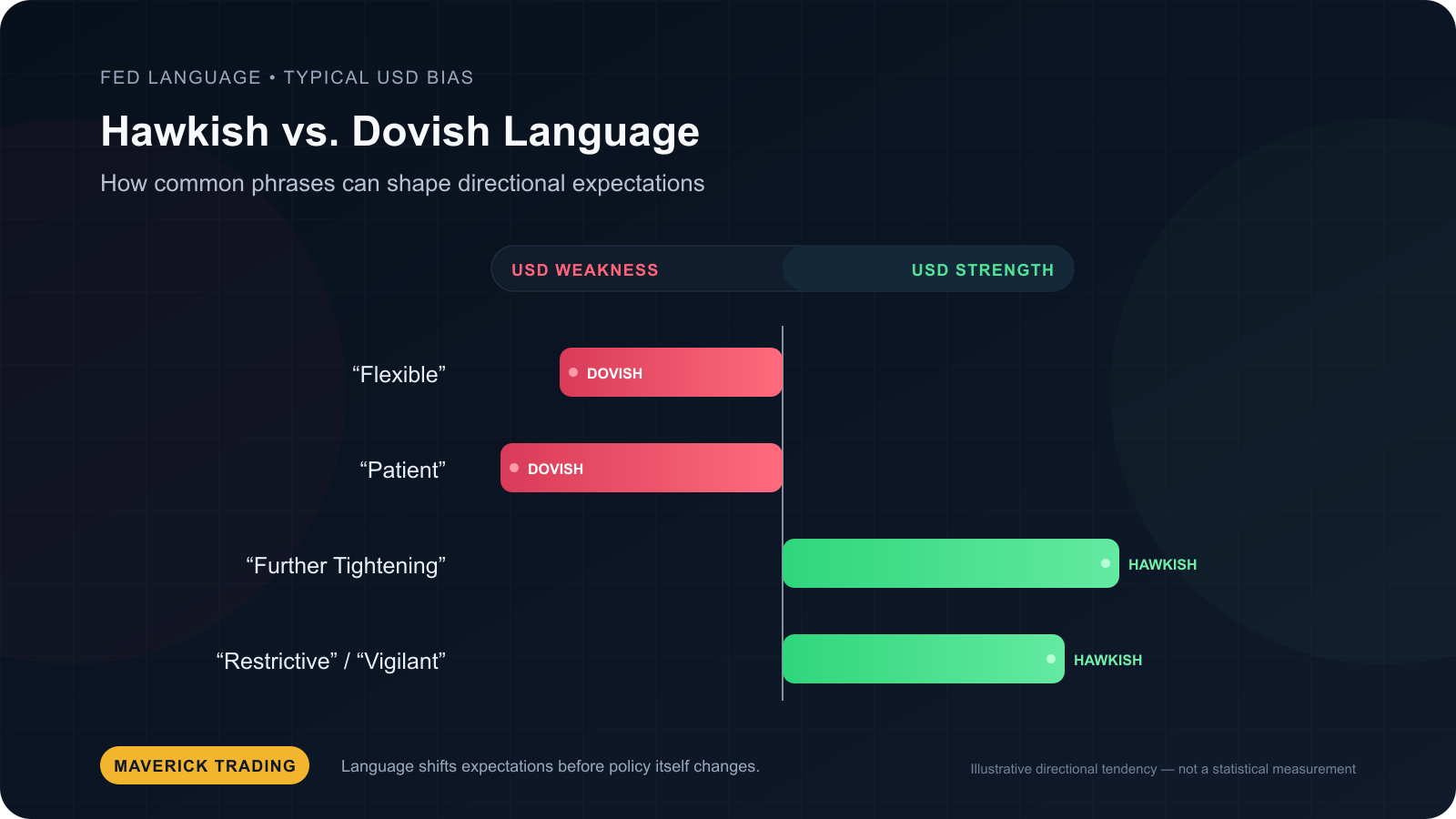
Illustrative directional tendency of hawkish vs. dovish Fed language on the dollar.
Many traders track how these comments filter into rate expectations using tools like the CME FedWatch tool, which translates Fed communication into implied probabilities for upcoming meetings. Reading that data alongside the speech itself gives a clearer picture of how the market is repricing the rate path in real time, and it is worth checking before and after any major Fed address rather than relying on a single snapshot.
Trading Strategies for Fed Speech Days
Knowing what to listen for is only half the equation. Turning that into a repeatable trading plan is where most of the real work happens, and it starts with the same discipline that professional traders use to manage risk on every other high-impact event.
Pre-Speech Positioning
Build positions 24 to 48 hours before Jackson Hole. Analyze prior Fed rhetoric, current rate expectations, and consensus forecasts to bias your directional trade entry. Going in with a clear thesis, rather than reacting blindly to the first headline, is what separates a planned trade from a guess.
Breakout Setups
Identify key technical levels before the event, then wait for confirmed breakouts above resistance or below support that are triggered by hawkish or dovish language shifts. Chasing the first tick of movement is a common mistake. Waiting for confirmation costs a few pips of entry price but filters out a lot of noise.
Volatility Plays
Buy straddles or strangles on major pairs like EUR/USD and USD/JPY ahead of the speech. Elevated implied volatility ahead of a known event like this creates real opportunities for options traders who want exposure to the size of the move rather than its direction.
Risk Management
Reduce position size by roughly half during the live speech itself. Set hard stop losses, avoid averaging into losing positions, and never hold unhedged positions through the question and answer session that follows, since that portion of the event can produce just as much volatility as the prepared remarks.
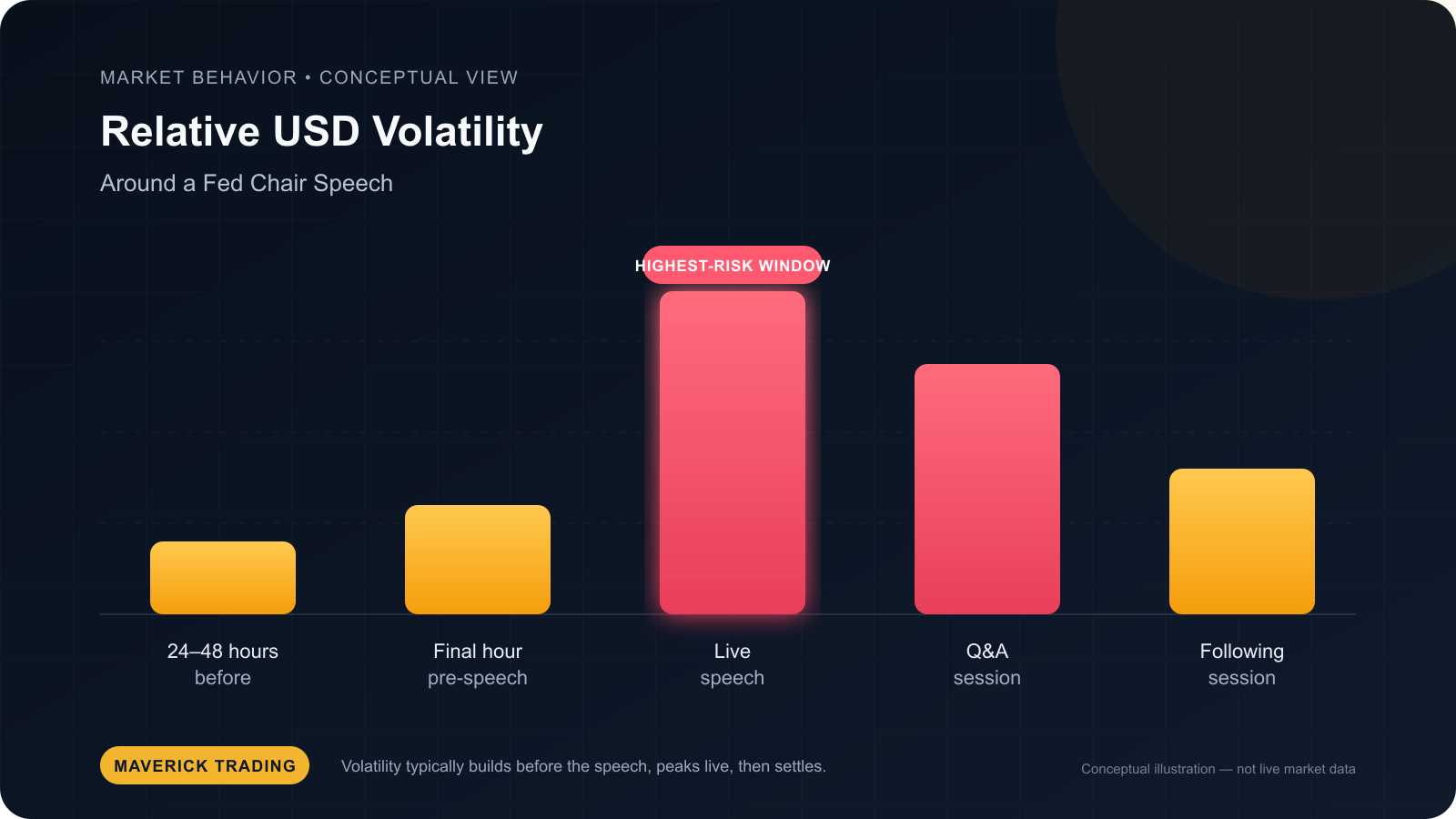
Volatility typically builds before the speech, peaks during the live remarks, and settles over the following session.
Volatility around a Fed speech does not move in a straight line. It tends to build gradually in the 24 to 48 hours before the address, tick up further in the final hour as positioning tightens, spike sharply during the live remarks, stay elevated through the Q&A, and then gradually settle in the following session. Traders who size their risk to match that curve, rather than treating the whole event as one flat window, tend to come out of Jackson Hole in much better shape than those who hold a flat position size straight through the entire day.
It also helps to remember that the market often reacts more to the surprise than to the substance. A hawkish speech that lands roughly in line with what traders already expected can produce a fairly muted move, while a modest, unexpected shift in tone relative to those same expectations can trigger an outsized reaction. That is why the pre-speech positioning step matters as much as the speech itself. Knowing the baseline expectation is what allows you to correctly judge whether the actual remarks are hawkish, dovish, or simply in line.
"It also helps to remember that the market often reacts more to the surprise than to the substance."
Why This Matters Beyond Jackson Hole

The skills built around Fed speech days do not stay confined to one week in August. Reading central bank language, managing volatility exposure, and sizing risk around scheduled catalysts are core parts of trading any liquid market, and they are a big part of what proprietary trading firms look for when evaluating traders for firm capital.
Jackson Hole will keep producing outsized moves in currency markets for as long as the Fed Chair's words carry weight with global investors. The traders who treat it as a repeatable process, built on clear signals and disciplined risk management, are the ones who consistently turn that volatility into opportunity instead of getting caught on the wrong side of it.
If you want to see what a real trading career looks like, and how mentorship and firm backing change the way you approach events like this, apply to Maverick Trading today.