
Position Sizing Mastery: The Key to Consistent Risk Management in Every Trade
Position sizing is the single decision that determines whether one bad trade costs you a manageable dip or your entire month of gains. It is not about picking the right stock, the right strike, or the right entry. It is about answering one question before you ever click the buy button: how many shares, contracts, or lots should this trade actually carry?
Most new traders skip this step entirely. They decide how much to risk based on how confident they feel, how much cash happens to be sitting in the account, or how badly they want the trade to work. That is a mistake that compounds quietly until it does not. Traders who last treat position sizing as a fixed part of their process, not a feeling they check in on trade by trade.
“That is a mistake that compounds quietly until it does not.”
What Is Position Sizing?
Position sizing is the process of determining how many units to trade so that each trade carries the same level of risk. Instead of betting random amounts, you define a fixed percentage of your capital at risk per trade, which keeps your losses consistent and manageable no matter what the market does.
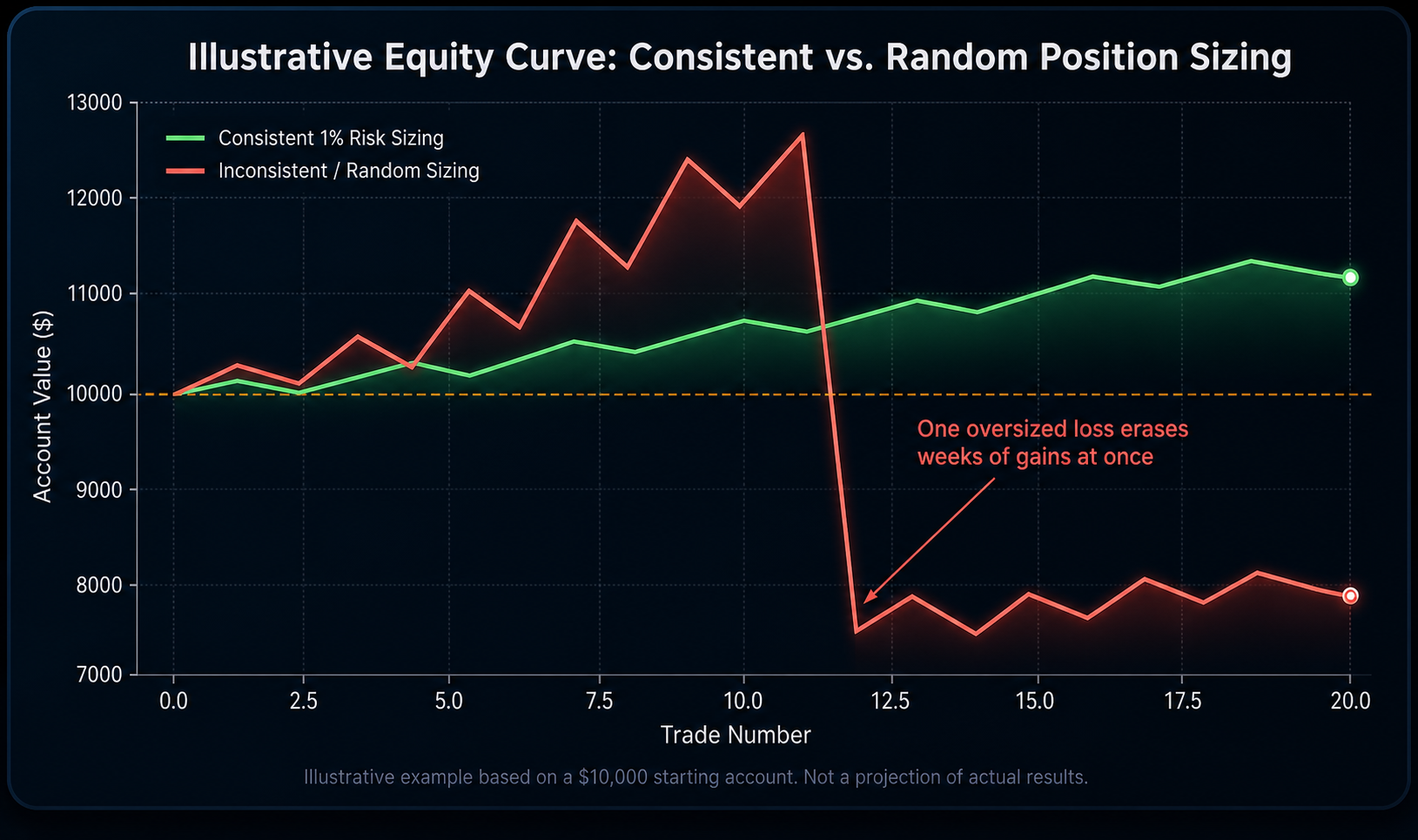
Without consistent position sizing, one bad trade can wipe out the gains from ten good ones. Equal risk per trade is the foundation of long-term survival and profitability across any market, whether you trade stocks, options, forex, futures, or cryptocurrency. It is also one of the habits that separates traders who are still around after five years from traders who are not. If you want a broader picture of what that long-term path actually looks like, How to Build a Professional Trading Career: What It Actually Takes breaks down the habits that hold up over time, and position sizing is near the top of that list.
How Do You Calculate Position Size?
The math behind position sizing is simpler than most traders expect. It comes down to four steps.
1. Set your account risk percentage
Decide what percentage of your total account you are willing to risk on a single trade. Most professional traders risk between 1% and 2% per trade to protect their capital over the long run.
2. Calculate your dollar risk per trade
Multiply your account balance by your chosen risk percentage. On a $10,000 account with 1% risk, that works out to $100 of dollar risk per trade. This is the maximum you can lose on any single position.
3. Identify your stop-loss distance
Determine the distance in price between your entry point and your stop-loss level. This defines how much the market can move against you before you exit the trade.
4. Calculate your final position size
Divide your dollar risk by your stop-loss distance: Position Size = Dollar Risk / Stop-Loss Distance. This ensures consistent risk across every trade you take, regardless of the asset or its volatility.
The chart below shows what that consistency looks like over time compared to sizing trades on gut feel.
Why Position Sizing Matters
Proper position sizing does more than cap your losses. It changes how you trade.
Emotional control
Equal risk per trade eliminates emotional decision-making. You trade with confidence knowing no single loss can significantly harm your account.
Consistent results
When risk is uniform across all trades, your win rate and edge produce predictable, measurable outcomes over time, which removes guesswork from your process.
Capital preservation
Limiting exposure on every trade protects your account from catastrophic drawdowns, keeping you in the game long enough to grow consistently.
Position sizing is really just one piece of a larger discipline. For a deeper look at how professionals build that discipline into every part of their process, see How Professional Traders Manage Risk.
Position Sizing in Action: Three Real Examples
Numbers make this easier to trust than theory does. Here is how the formula plays out across three different asset classes, all using the same $10,000 account and the same 1% ($100) risk tolerance.
Example 1: Futures Trade
An S&P 500 micro contract has a tick value of $1.25. With a stop loss set at 20 ticks, that is $25 of risk per contract. Dividing the $100 risk tolerance by $25 gives a position size of 4 contracts.
Example 2: Stock Trade
A stock with a stop loss set $3.48 from entry divides into the $100 risk tolerance for a position size of roughly 28 shares, carrying about $97 of risk on the trade, just under the tolerance line.
Example 3: Options Trade
An option with an entry premium of $6.75 per share ($675 per contract) and a stop set at $5.10 per share ($510 per contract) carries $165 of risk per contract. That exceeds the $100 risk tolerance, which means the correct position size is not “one contract carefully managed.” It is no trade at all.
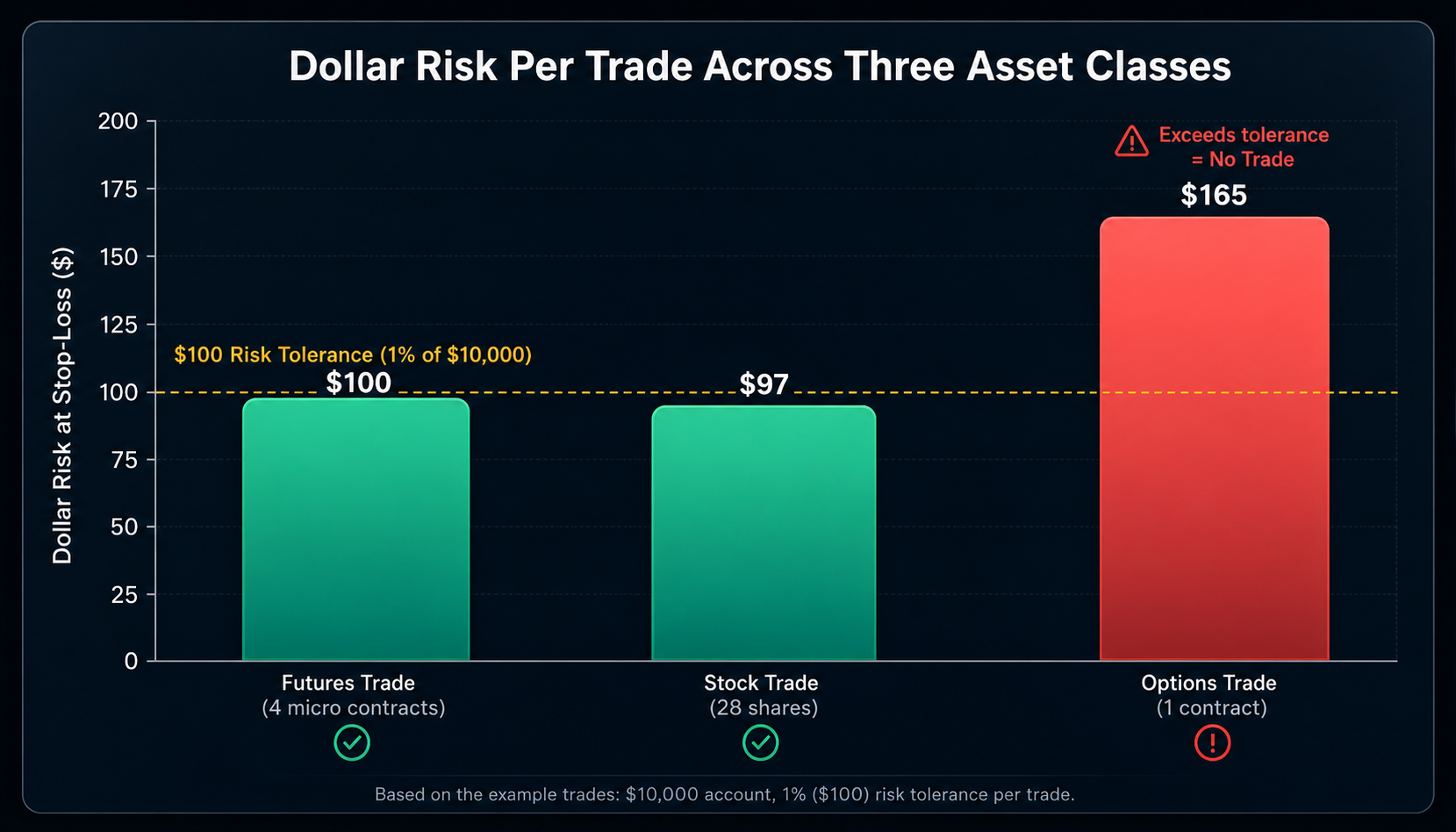
That third example is the one traders skip past the fastest, and it is the most important one on the list. Position sizing is not only a formula for how much to buy. It is also a filter for when the math tells you to pass.
“Position sizing is not only a formula for how much to buy. It is also a filter for when the math tells you to pass.”
Running a trade through a consistent checklist before you size it can catch exactly this kind of setup before it becomes a live position. 5 Questions to Ask Before Every Trade: A Trading Checklist walks through the questions worth asking before every entry, position sizing included.
Why Consistency Matters More Than Confidence
Once you have defined your personal risk tolerance and learned how to properly position size your trades, the next step is applying it every single time, regardless of how you feel about the trade.
That last part is where discipline actually gets tested. It is easy to size trades correctly when you feel good about the setup. The real test is sizing the trade you are not sure about the same way you size the one you love. Skip that consistency and you introduce bias toward the trades you want to win on and the ones you can mentally handle losing. And bias, at its core, is just emotion wearing a spreadsheet.
“And bias, at its core, is just emotion wearing a spreadsheet.”
Frequently Asked Questions
What percentage should I risk per trade?
Most professional traders risk between 1% and 2% of their account per trade. Lower percentages mean smaller drawdowns during losing streaks, at the cost of slower account growth during winning ones.
What do I do if a trade's calculated risk exceeds my tolerance?
Pass on it, or look for a tighter stop-loss level or better entry price that brings the risk back within your tolerance. As the options example above shows, sometimes the correct position size is zero.
Does position sizing work the same way across stocks, futures, and options?
The formula is identical across asset classes: dollar risk divided by stop-loss distance. What changes is how that distance is priced, whether in tick values, share price movement, or option premium.