
5 Questions to Ask Before Every Trade: A Trading Checklist
Every trade you place should be able to answer five questions before you ever click the button. Not after. Not while you're watching it move against you. Before. These questions to ask before every trade are the difference between a trader working from a plan and a trader working from a hope, and they take less than a minute to run through once the habit sticks. None of the five require special software, indicators, or a course. They require slowing down for sixty seconds before every single entry, which turns out to be the hardest part for most people.
The 5 Questions to Ask Before Every Trade
Run through these in order, every time, and the guesswork mostly disappears.
Question 1: What's the Trend?
Start by identifying market direction. Determine if price is making higher highs and higher lows, which is an uptrend, or lower highs and lower lows, which is a downtrend, on your primary timeframe. This sounds obvious, but it's the step most often skipped when a setup looks exciting.
Once you know the direction, align your timeframes. Confirm the trend on a higher timeframe first, then drop down to your entry timeframe for precision. Never fight the higher timeframe. A great-looking entry on a 15-minute chart means very little if the daily chart is pointed the opposite direction.
Question 2: Where Am I Wrong?
This is the question that separates traders who survive from traders who don't. Define your stop loss level before entering. This is the exact price where your trade thesis is invalidated, not where you feel pain. Those are two very different numbers, and confusing them is how small losses turn into account-ending ones.
Your invalidation point should come from the chart, from a level that would prove your idea wrong if price reaches it, not from how much money you're comfortable losing. If you can't identify that price before you enter, you're not ready to enter.
"If you can't identify that price before you enter, you're not ready to enter."
A stop loss set after the fact, once the trade is already underwater and uncomfortable, isn't a stop loss. It's a hope that price turns around before the damage gets worse, and hope has never been a risk management strategy.
Question 3: What's My Target?
Set a clear profit objective before you enter. Identify a realistic profit target based on key resistance, support levels, or measured moves, and know your exit before you enter. A trade without a predefined target turns into a guessing game the moment it starts working, and guessing games are where discipline goes to die.
"A trade without a predefined target turns into a guessing game the moment it starts working, and guessing games are where discipline goes to die."
Question 4: What's My Risk?
Once you know your entry and your stop, the math writes itself. Calculate your risk in dollars: entry price minus stop loss. This must be a predefined number, not something you calculate after the trade is already open and moving. Knowing your risk in dollars, not just in percentage terms, is what makes position sizing possible in the next step.
Question 5: Is the Reward Worth It?
This last question pulls everything together, and it has three parts.
First, your risk/reward ratio. Divide your target gain by your expected loss if your stop loss is hit. If the potential gain doesn't justify the risk relative to probability, skip the trade entirely, no matter how good the chart looks.
Second, your personal risk tolerance. Know your max dollar loss per trade before you enter. Never let one trade risk more than 1 to 2 percent of your account. This single rule is one of the most repeated pieces of advice in trading for a reason: it's the one that keeps you in the game long enough to get good.
"Never let one trade risk more than 1 to 2 percent of your account."
Third, position sizing. The formula is simple: personal risk tolerance per trade, divided by risk per share, equals total shares allowed to trade. Position size isn't something you eyeball. It's an output of the first four questions, not a separate decision.
A Real Trade, Walked Through the Checklist
Here's what that looks like with real numbers. Say you're looking at an entry price of $77.19, with a stop loss at $74.71 and a profit target at $83.41.
Your risk is $77.19 minus $74.71, or $2.48 per share. Your reward potential is $83.41 minus $77.19, or $6.22 per share. Divide reward by risk, and you get a 2.5-to-1 reward-to-risk ratio, comfortably above the threshold most traders look for before taking a setup seriously.
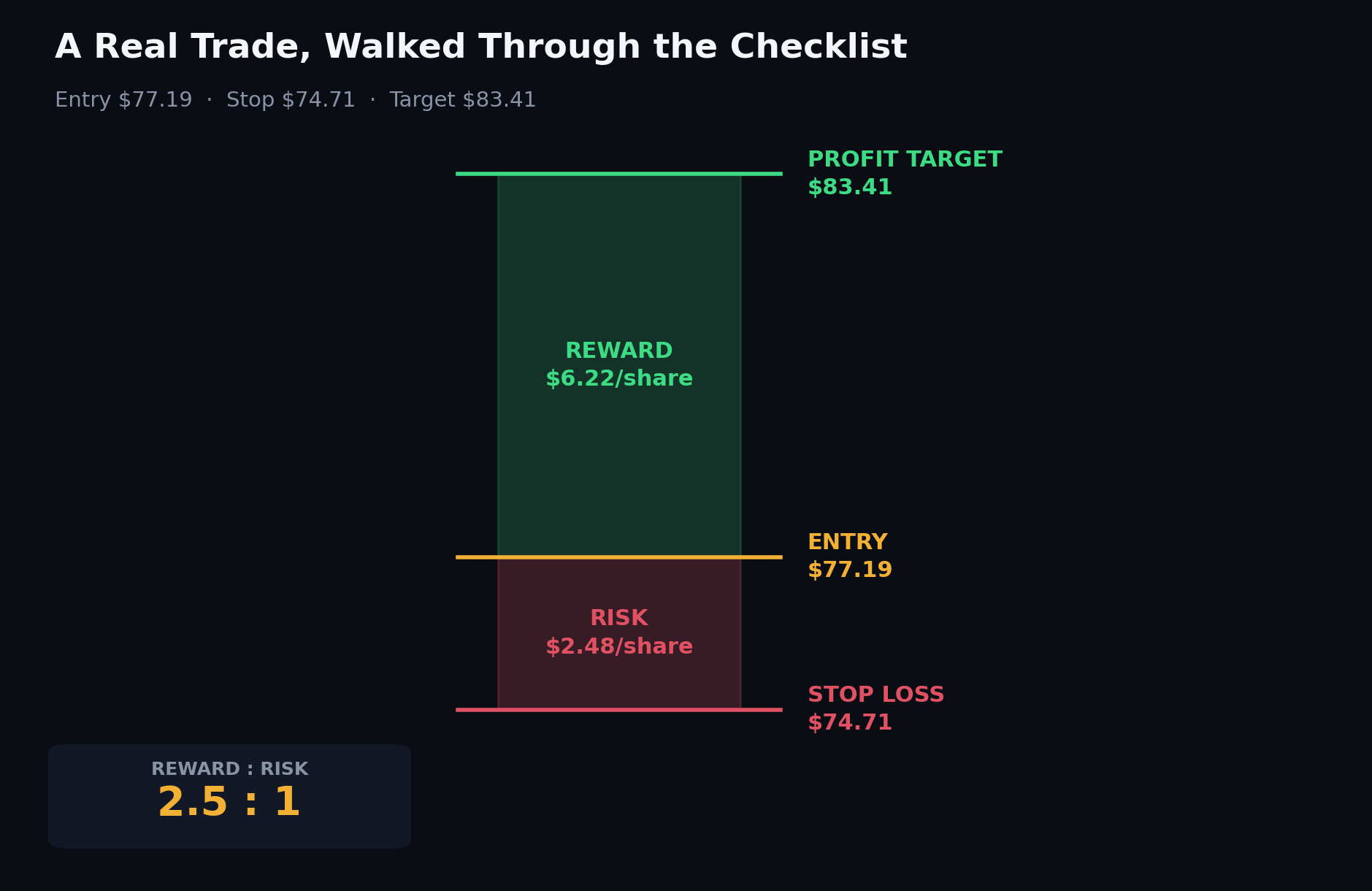
Entry, stop, and target for a real trade setup: a 2.5:1 reward-to-risk ratio.
Now run it through the position sizing formula. On a $10,000 account, a 1 to 2 percent risk tolerance works out to a $100 to $200 risk budget per trade. Take the $200 figure, divide it by your $2.48 risk per share, and you land on roughly 40 shares. That's not a number you picked because it felt right. It's a number the math produced, based on decisions you made before you ever entered the trade.
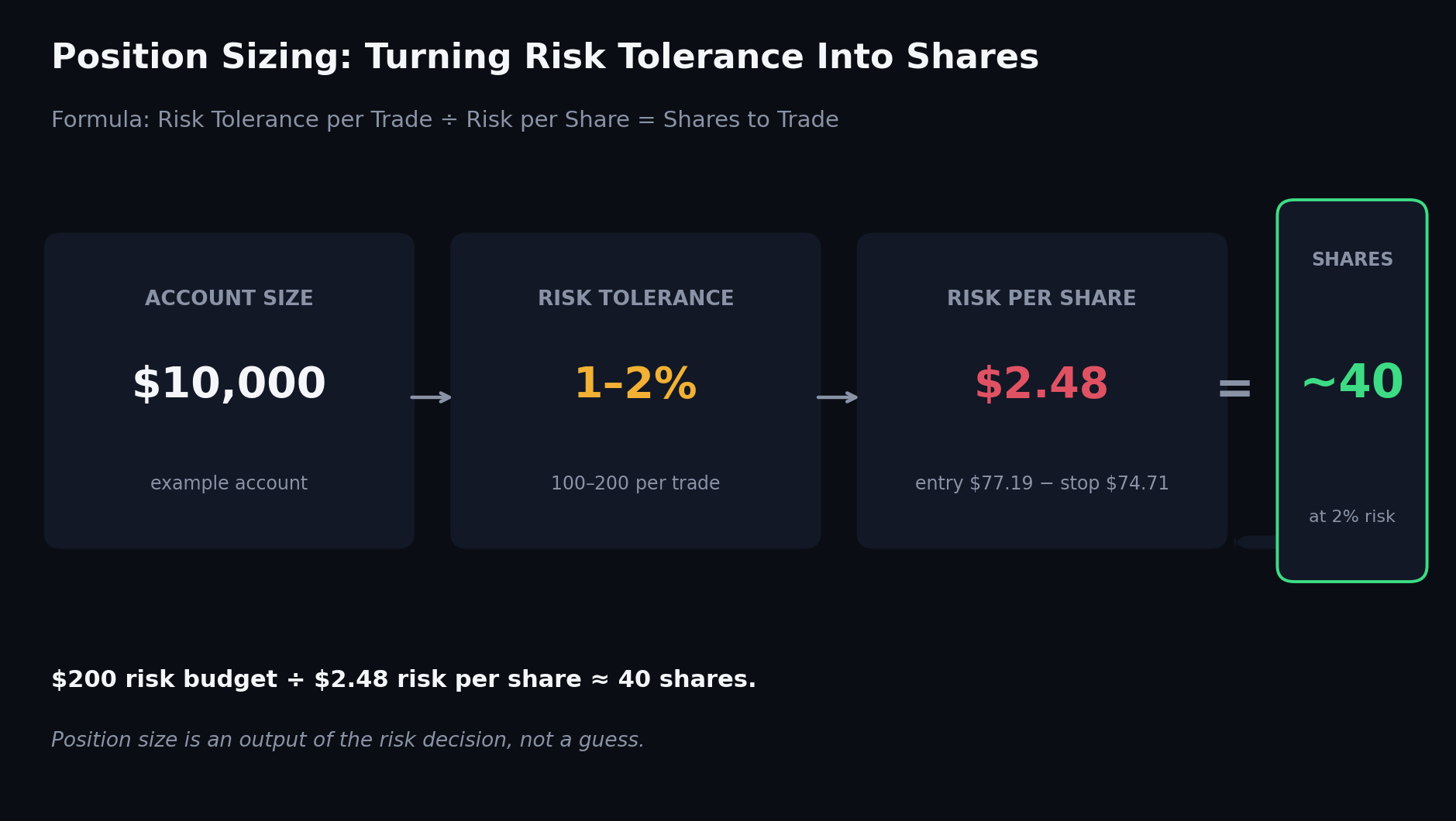
Position sizing is an output of your risk decision, not a guess.
This is also where How Professional Traders Manage Risk becomes useful reading, because this exact process, defining risk before reward and sizing positions off of it rather than gut feel, is the throughline in how professional trading operations actually manage capital day to day. It isn't a special technique reserved for advanced traders. It's the baseline.
Why This Framework Separates Consistent Traders From Everyone Else
None of these five questions are complicated on their own. What's hard is answering all five, in order, every single time, especially on the trades that feel obvious. The obvious ones are exactly where discipline tends to slip, because it feels unnecessary to slow down and check your work on a setup you're already confident about. That's usually the moment a trader skips question two or four, and it's rarely a coincidence that the trades people remember losing the most on are the ones where they felt the most certain going in.
That consistency is worth understanding on its own terms, and Why Professional Traders Keep Winning (and It's Not Just Skill) goes deeper into why repeatable process, not raw prediction ability, is what actually compounds over a career. Skill gets you a good trade here and there. Process is what turns good trades into a track record, and process only works if it's applied the same way regardless of how the last trade went.
Building that kind of process doesn't happen by accident, and it rarely happens alone. It's built through repetition, feedback, and the kind of structure that catches the mistakes you can't see in yourself yet. Most traders who struggle aren't struggling because they don't understand these five questions intellectually. They're struggling because nobody is checking whether they actually answer them, trade after trade, when it's inconvenient to slow down. If you're serious about developing that process rather than reinventing it trade by trade, How to Build a Professional Trading Career: What It Actually Takes lays out what that path really looks like.
Every trade should answer these five questions. Not most trades. Not the ones that feel important. Every single one, because the habit only protects you if it's unconditional. Traders who are serious about making this a career explore what it looks like to trade with firm backing.