
Why Professional Traders Keep Winning (And it's Not Just skill)
Every few months, another headline appears about politicians, hedge funds, or institutional investors making well-timed trades before major market events. Retail traders often react with frustration, believing the game is rigged and why professional traders keep winning is because they have access to information no one else does.
While those headlines certainly raise important ethical questions, they also reveal something much deeper.
Professional traders don't succeed because they're smarter. They succeed because they build structural advantages that create consistent results over thousands of trades, not because they occasionally make a lucky prediction.
The good news?
You don't need inside information to develop an edge. You simply need to understand how professionals approach the market differently.
Markets Reward Process, Not Predictions
Many new traders believe success comes from predicting exactly where a stock will go next.
Professionals know better.
No trader can consistently predict the future. Markets are influenced by earnings, economic reports, interest rates, geopolitical events, institutional flows, and countless other variables that no individual can fully anticipate.
Instead of trying to be right all the time, professionals focus on creating repeatable processes that generate positive expectancy.
That means asking questions like:
- Is this trade statistically favorable?
- Does it fit my trading plan?
- Is the risk acceptable?
- Does the reward justify taking the position?
Winning becomes the result of executing a proven system, not making perfect forecasts.
Structural Edge Beats Informational Edge
When people hear stories about congressional stock trades or institutional investing, they often assume professionals win because they know something everyone else doesn't.
In reality, informational advantages are only one possible edge, and for most professional traders, they're completely irrelevant.
Instead, professionals rely on structural advantages such as:
- Strict risk management
- Consistent position sizing
- Trading only high probability setups
- Emotional discipline
- Statistical tracking
- Capital preservation
- Continuous review and improvement
These advantages compound over time.
Retail traders often spend months searching for the "perfect indicator" while ignoring the systems that actually create long term profitability.
Professionals Think in Probabilities, Not Predictions
One of the biggest mindset shifts occurs when traders stop asking:
"Will this trade win?"
Instead, they ask:
"Does this trade have positive expectancy?"
Even great trading systems lose regularly.
A strategy with a 45% win rate can outperform one that wins 70% of the time if the average winner is significantly larger than the average loser.
Professionals accept losses as part of doing business because they understand probabilities.
Individual trades don't matter nearly as much as long term execution.
This mindset removes enormous emotional pressure from every decision.
Risk Management Creates Staying Power
Many retail traders focus almost entirely on entries.
Professionals spend far more time managing risk.
Every position begins with clearly defined answers:
- How much capital is at risk?
- Where is the exit if the trade fails?
- What position size fits current market conditions?
- How much exposure already exists?
The objective isn't maximizing today's profit.
It's protecting tomorrow's opportunity.
A trader who preserves capital can continue compounding gains.
A trader who overextends during one bad week often never recovers.
Professional trading is less about making spectacular gains than avoiding catastrophic losses.

Psychology Is Often the Real Difference
The markets challenge human psychology every day.
Fear causes traders to exit winning positions too early.
Greed encourages oversized positions.
Hope keeps losing trades open far too long.
Revenge trading leads to emotional decisions after losses.
Professionals aren't immune to these emotions.
The difference is that they build systems specifically designed to reduce emotional decision-making.
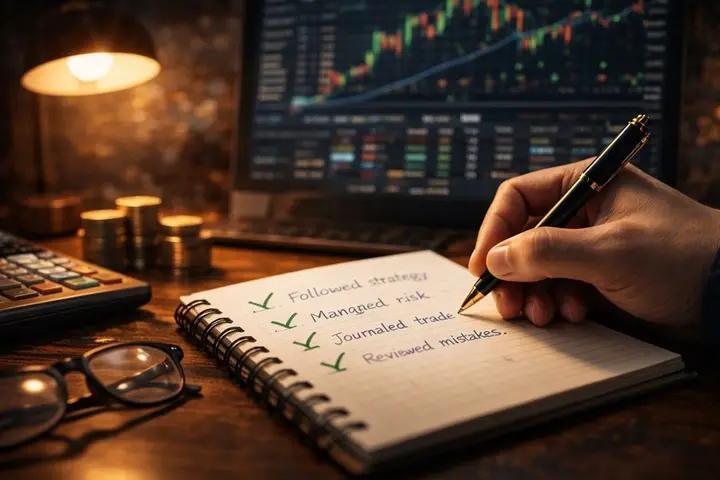
Trading journals, written plans, predefined exits, and routine performance reviews all help remove emotion from execution.
As explored in Understanding Market Psychology, mastering your own behavior is often more valuable than discovering another technical indicator.
Consistency begins with consistency of behavior.
Capital Is Managed, Not Gambled
Professional traders view capital as inventory.
Every dollar represents future opportunity.
Because of this mindset, they become extremely selective about where they deploy risk.
Instead of asking:
"How much can I make?"
They ask:
"Is this the best use of my capital today?"
Sometimes the highest-quality decision is doing nothing.
Patience is one of the least appreciated professional skills.
Waiting for high-quality opportunities often produces better long-term returns than constant activity.
This disciplined approach to deploying capital is a cornerstone of professional trading. Learn more in our article on Capital Allocation, where we discuss how experienced traders decide when, and when not, to commit capital.
Professional Habits Compound
Many traders search for one breakthrough strategy.
Professionals know success comes from dozens of small advantages working together.
Examples include:
- Reviewing trades every week.
- Following written rules.
- Limiting risk on every position.
- Maintaining detailed trading journals.
- Tracking performance metrics.
- Avoiding impulsive decisions.
- Remaining patient during uncertain markets.
None of these habits create overnight success.
Together, however, they build consistency that compounds over years.
Small improvements repeated hundreds of times become significant competitive advantages.
The Goal Isn't Winning Every Trade
One of the biggest misconceptions about professional trading is that professionals rarely lose.
The opposite is true.
Professional traders lose frequently.
What separates them is that losses are planned, limited, and emotionally accepted.
They don't judge themselves based on one trade.
They judge themselves based on whether they followed their process.
Ironically, traders who become less obsessed with being right often become more profitable.
Why Professional Traders Keep Winning: Build Your Own Professional Edge
Professional traders aren't defined by secret information or extraordinary intelligence.
They're defined by discipline.
Their edge comes from systems, preparation, risk management, psychology, and consistency.
These are skills anyone can develop with education, practice, and experience.
Markets will always contain uncertainty.
The traders who succeed are the ones who learn to manage that uncertainty better than everyone else.
If you're ready to trade professionally with firm capital behind you, see how Maverick's application works and learn what it takes to trade within a structured professional environment.