
Post-Fed Week: What Professional Traders Do After a High-Volatility Fed Week
The Post-Fed Week Routine That Separates Professionals From Amateurs
Jackson Hole is over. Powell has spoken. The Post-Fed Week market has reacted — violently, chaotically, or quietly, depending on what was said and what was priced in. The initial spike has come and gone. The weekend is here.
And now comes the part that separates professionals from everyone else.
Amateurs close their platforms Friday afternoon and don't think about Jackson Hole again until Monday morning — when they open their charts with no idea what they learned, what they did wrong, or whether their risk parameters still make sense in the new environment. They move on. They forget. And they make the same mistakes at the next high-impact event because they never did the work to understand what happened at this one.
"Professionals do the work. They review. They reset."
Professionals do the work. They review. They reset. They extract every lesson the event offered — not just from the trades they took, but from the trades they didn't take, the levels that held or broke, and the emotional decisions they made under pressure. Then they adjust their parameters, update their playbook, and show up Monday morning sharper than they were on Friday.
Here's the post-Fed week routine that professionals run — and that you should run this weekend.
Step 1: The Immediate Download (Friday Afternoon)
Before you close the platform for the weekend, do a quick brain dump. This is not the deep analysis. That comes later. This is the raw, unfiltered capture of what happened while it's still fresh.
Write down three things:
- What was expected, and what actually happened?
Don't overcomplicate this. One sentence each. "Markets expected a dovish signal with a clear path to September cuts. Powell delivered cautious language emphasizing data dependence and tariff-driven inflation risks." That's it. The gap between expectation and reality is where the tradeable move lived — and understanding that gap is the foundation of everything you'll review.
- What did I do?
Not what you should have done. Not what you wish you'd done. What you actually did. Did you trade the speech or the reaction? Did you follow your plan or deviate? Did your stop get hit? Did you close early? Did you sit on your hands the whole time? Be brutally honest. This is for you, not for anyone else.
- What was my emotional state at entry and exit?
Write down the feeling. Rushed? Patient? Anxious? FOMO-driven? Calm? Revenge-seeking after an earlier loss? Emotional state at the moment of decision is one of the most predictive variables in trading — and almost no one tracks it. The Friday download captures it before memory sanitizes the experience.
This takes five minutes. Do it before you leave the desk. The longer you wait, the more your brain will rewrite the narrative to make yourself feel better.
Step 2: The Structured Review (Saturday or Sunday)
The Friday download is raw material. The structured review is where you turn that material into actionable intelligence. Set aside 30-45 minutes sometime this weekend. Coffee. Notebook. No distractions.
Reconstruct the Key Moments
Pull up the chart for the instrument you traded — or the one you planned to trade. Mark the exact time of Powell's speech. Now identify the three or four key moments on the chart:
- The initial spike (first 1-5 minutes)
- The first reversal or fakeout
- The eventual directional resolution (30-90 minutes after the speech)
- Any significant level that held or broke
At each of those moments, ask: What was I doing? What was my plan telling me to do? Was there a gap between the two?
Grade Every Trade on Process, Not Outcome
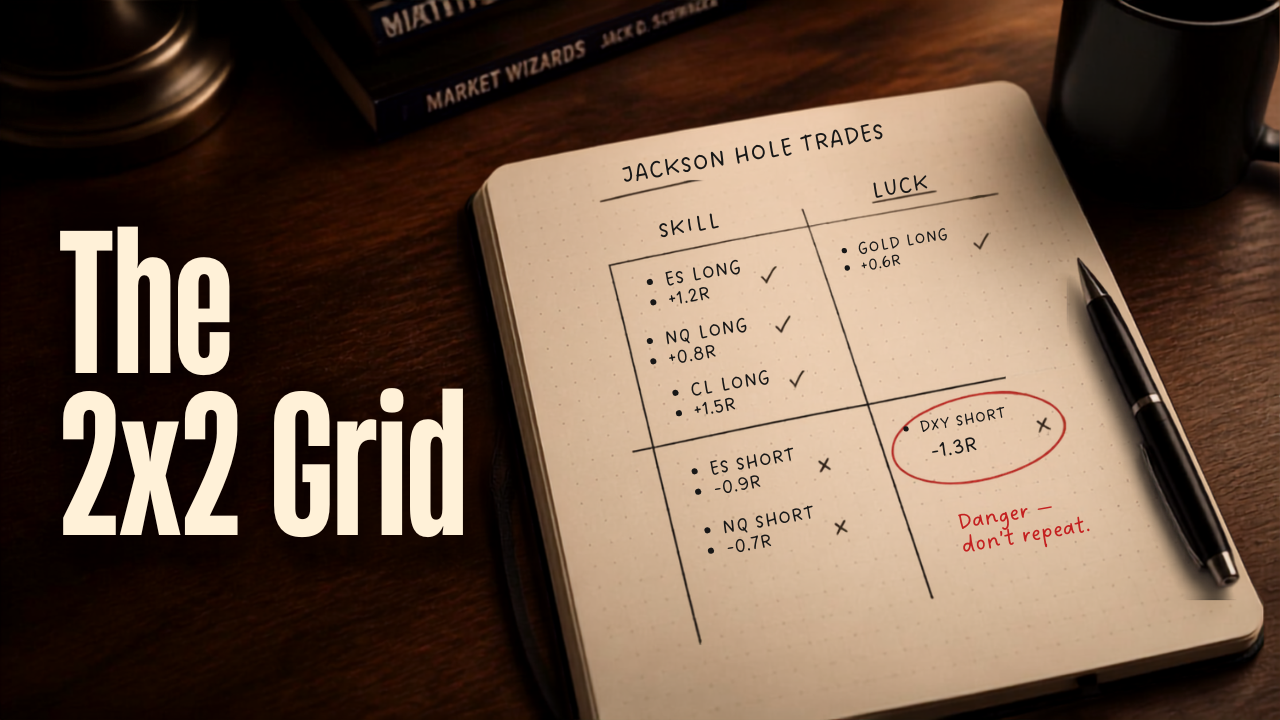
This is the single most important distinction in trade review, and most traders get it backwards. They judge trades by whether they made money. Professionals judge trades by whether they followed the plan.
Use a simple 2x2 grid:
Good Outcome
Bad Outcome
Good Process
Skill — reinforce
Variance — accept
Bad Process
Luck — don't repeat
Mistake — fix
"A trade that lost money but followed every rule is a process win."
A trade that lost money but followed every rule is a process win. A trade that made money but violated the plan is a process failure — and it's actually more dangerous than a loss, because it reinforces the behavior that will eventually blow up your account.
Go through every Jackson Hole trade and put it in one of these four boxes. If you have trades in the "Luck" or "Mistake" quadrants, those are your priorities for next time.
Measure Execution Quality
For each trade, compare what you planned to what actually happened:
- Entry: Did you enter at the planned level, or did you chase? If you chased, by how much?
- Stop: Did the stop stay where you set it, or did you move it? If you moved it, was it wider or tighter?
- Target: Did the trade hit your planned target, or did you exit early? If you exited early, what triggered the exit — a technical level or an emotional impulse?
- Slippage: Were your fills close to your intended prices, or did the event environment produce significant slippage? If slippage was worse than expected, your position sizing for the next event needs to account for that.
Calculate Your R-Multiples
For each trade, calculate the R-multiple: profit or loss divided by the original planned risk. A trade that made 2.3 times your planned risk is +2.3R. A trade that lost more than 1R means your stop was moved or your fill was worse than planned. Both are review triggers.
If your R-multiples for event trades are consistently negative or inconsistent, the issue isn't the event — it's your execution during the event. That's fixable. But only if you measure it.
Step 3: Extract the Lessons (One Sentence Each)
After you've reconstructed the trades and graded the process, extract the lessons. One sentence per lesson. Not a paragraph. Not a vague intention. Specific, actionable, testable.
Bad lesson: "I need to be more disciplined during Fed events."
Good lesson: "I entered 45 seconds before the 5-minute candle closed, which my plan explicitly told me not to do. Next event, I set a timer and do not touch the mouse until the candle closes."
Bad lesson: "I should have held the winner longer."
Good lesson: "My plan said take-profit at 1.0850. Price hit 1.0850 and I closed. That was correct. The fact that price continued to 1.0880 is variance, not an error."
Vague lessons don't change behavior. Specific ones do. If you can't write the lesson in a single sentence that describes exactly what you'll do differently next time, you haven't found the lesson yet.
Step 4: Reset Your Risk Parameters
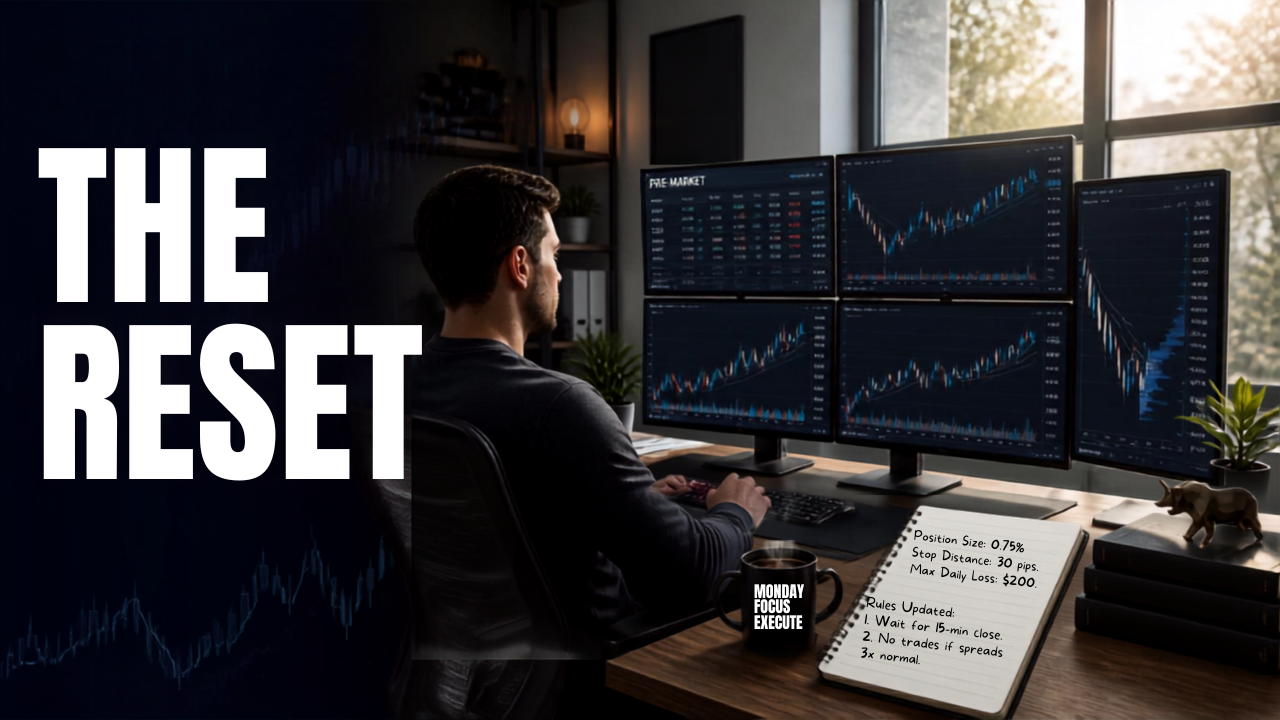
A high-volatility event like Jackson Hole often changes the market environment. Trends that were intact before the speech may be broken. Ranges that held for weeks may be violated. Volatility regimes may shift. Your risk parameters — position sizes, stop distances, session hours — were calibrated for the pre-event environment. They may not be calibrated for the post-event environment.
Go through each of these and ask whether they still make sense:
Position Sizing
Did the event produce larger moves than your normal sizing assumes? If EUR/USD moved 120 pips on Friday and your normal stop distance is 25 pips, your stops are too tight for the new volatility regime. Either widen them and reduce size proportionally, or wait for volatility to normalize before trading your usual parameters.
Stop Distances
Post-event markets often take a day or two to settle into new ranges. During that settling period, noise is higher and fakeouts are more common. Consider widening stops temporarily — with proportionally smaller position sizes — until the market establishes a new equilibrium.
Session Hours
If the event shifted the macro narrative significantly, the highest-quality trading sessions may change. A dollar-bullish outcome may make European session dollar pairs more attractive. A risk-on outcome may shift focus to equity indices during US hours. Adjust your session focus based on where the opportunity actually is — not where it was last week.
Maximum Risk Per Day
If the event environment is still producing elevated volatility on Monday and Tuesday, your normal daily loss limit may be too tight. Not because you should risk more — but because normal position sizes will produce larger P&L swings in a higher-volatility environment. Either reduce position sizes or accept that you may hit your daily limit faster than usual.
For a broader framework on how professional traders think about risk management — not just during events but as a continuous, adaptive process — our piece on how professional traders manage risk covers the principles that separate genuine risk oversight from static rule-following.
Step 5: Update the Rulebook
If any of the lessons you extracted in Step 3 are repeatable — if they apply to future high-impact events, not just this one — promote them to rules.
A rule is not an intention. A rule is a specific, written instruction that governs your behavior during defined conditions. It lives in your trading plan. You review it before every relevant session. You grade yourself on whether you followed it.
Examples of event-trading rules that might come out of a Jackson Hole review:
- "I do not enter a trade in the first 5 minutes after a Fed Chair speech begins."
- "I reduce position size by 50% on any day with a scheduled high-impact Fed event."
- "I set a hard stop before the event and do not move it wider under any circumstances."
- "If spreads are 3x normal or wider, I stand down entirely."
- "I trade the reaction, not the speech. Confirmation requires a 15-minute close beyond the pre-event range."
"Rules that aren't written down aren't rules. They're hopes."
Rules that aren't written down aren't rules. They're hopes. And hopes don't survive the next adrenaline spike.
Step 6: The Strategic Review (Monthly or Quarterly)
The post-event review described above is tactical — it focuses on individual trades and immediate execution quality. Once a month or once a quarter, zoom out for a strategic review that looks at patterns across multiple events.
Over your last three to five high-impact event trades:
- Which setup performed best? Did you do better trading the reaction than the speech? Better in forex than indices? Better fading the initial spike than following it?
- Which emotional state showed up most often? If "rushed" or "anxious" appears in your Friday download more than twice, you have a preparation problem, not an execution problem.
- Which rules were violated most frequently? If the same rule gets broken event after event, the rule may be unrealistic — or you may need a stronger circuit breaker to enforce it.
- What is your expectancy for event trades versus non-event trades? If your event-trade expectancy is negative while your normal trading is positive, the simplest fix is to stop trading events. Professionals know their edge. They also know where their edge doesn't exist.
What This Looks Like in Practice: A Sample Post-Jackson Hole Routine
Friday, 4:15 PM ET: Markets closed. Before leaving the desk, write the three-line download: expectations vs. reality, what I did, emotional state.
Saturday, 10:00 AM: Coffee. Notebook. Pull up EUR/USD 5-minute chart from Friday. Mark the four key moments. Reconstruct the one trade I took — a short at 1.0875 after the 15-minute confirmation close. Grade it: followed the plan, hit target at 1.0850 for +25 pips. Process: Good. Outcome: Good. Quadrant: Skill. Lesson: "Waiting for the 15-minute close kept me out of the initial fakeout spike. This rule stays."
Saturday, 10:30 AM: Review risk parameters. Friday's range was 110 pips — roughly 1.5x normal daily range. Volatility may remain elevated Monday-Tuesday. Decision: reduce position size to 0.75% risk per trade until daily ranges normalize below 80 pips. Widen stops by 5 pips with proportionally smaller size.
Saturday, 10:45 AM: Update rulebook. Add one rule: "For all Fed Chair speeches, wait for the 15-minute candle to close before entering. No exceptions."
Monday, 8:00 AM: Review the updated rulebook before the session. Trade smaller. Trade cleaner. Move on.
The Takeaway
The market doesn't care what you learned from Jackson Hole. It doesn't care whether you followed your plan or chased the spike. It doesn't care whether you're reviewing your trades or skipping the post-mortem and hoping for better luck next time.
But your P&L cares. Your development as a trader cares. Your ability to survive the next high-impact event — and there will always be a next one — depends entirely on whether you did the work after this one.
Professionals don't treat the post-event weekend as time off. They treat it as part of the trade. The review is not optional. The reset is not optional. The rulebook update is not optional. These are the activities that compound — the feedback loops that turn a trader who sometimes gets lucky into a trader who consistently executes.
Jackson Hole 2026 is in the books. The question is whether you'll extract everything it has to teach you — or whether you'll show up at the next Fed event with the same plan, the same gaps, and the same results.
If you're ready to develop the kind of structured, process-driven approach that professional traders rely on — including the post-event routines that turn experience into improvement — find out what a real trading career looks like at Maverick Trading, where profit-sharing, real capital, and professional development have been the model since 1997.
Disclaimer: This content is for informational and educational purposes only. It does not constitute financial advice. Trading foreign exchange, equities, options, futures, and other financial instruments involves substantial risk of loss and is not suitable for every investor. Past performance is not indicative of future results. Always consult with a qualified financial professional before making any trading decisions.