
Hidden Prop Trading Fees: What to Check Before You Apply
Not all prop trading firms make money the same way. And the way a firm makes money tells you everything about whether its hidden prop trading fees are designed to develop your career — or extract value from your attempts.
The prop firm industry has split into two fundamentally different models. One charges you to prove yourself, then charges you again when you fail, and again to activate your account if you pass. The other charges a straightforward membership for training, coaching, and access to real capital — then makes its real money the same way you do: by taking a share of trading profits.
The difference sounds subtle. It's not. It's the difference between a business built on trader failure and a business built on trader success.
"It's the difference between a business built on trader failure and a business built on trader success."
Here's exactly where the hidden costs live in the challenge model, how to spot them, and what a genuine development-focused prop firm looks like by comparison.
The Two Revenue Models: Why It Matters Before You Pay a Dime
Before you evaluate any prop firm's fees, you need to answer one question: how does this firm primarily make its money?
The Challenge Model: Revenue From Attempts
In a challenge-model firm, revenue comes primarily from the evaluation process. Traders pay a challenge fee to enter. If they pass, they may get a funded account — though whether that account trades real capital or simulated liquidity varies significantly by firm. If they fail, they can reset — for another fee.
The economics are straightforward: with industry pass rates estimated in the single digits, the vast majority of challenge fees are never refunded. Reset fees compound the revenue. Activation fees, monthly platform subscriptions, and data charges add additional layers. The firm is profitable whether traders succeed or fail — and in some structures, failure is actually more profitable than success, because a failed trader resets and pays again while a successful trader eventually takes a share of profits.
This doesn't make every challenge firm a scam. But it does mean the incentive structure is not aligned with trader development. The firm's financial interest is in the evaluation process continuing — not necessarily in the trader graduating from it.
The Development Model: Revenue From Shared Success
In a genuine development-focused prop firm, the economics are different. There may be a membership or subscription fee — but that fee pays for something real: training, coaching, mentorship, trade review, and access to a professional development structure. It's not a bet on passing a test. It's tuition for an education.
And the firm's primary revenue — the reason the business exists — comes from the same place the trader's does: trading profits. The firm takes a share of what its traders earn. If the trader doesn't make money, neither does the firm.
This alignment changes everything:
- The firm wants you to succeed. Every dollar spent on coaching and development is an investment in future profit-share revenue — not a cost center to be minimized.
- Risk rules are designed to protect real capital from real losses — not to produce breach events at a commercially useful frequency.
- There are no activation fees because the capital is real and the firm has already committed it. There's nothing to "activate."
- There are no reset fees because there's no challenge to reset. You're either developing as a trader or you're not — and the firm is invested in the former.
For a deeper breakdown of how these models differ and what to look for across every dimension of a prop firm's structure, our prop firm comparison guide for 2026 walks through the five factors that actually matter: capital structure, revenue model, development environment, risk rule design, and long-term fit.
Hidden Prop Trading Fees Checklist: What Challenge-Model Firms Don't Put on the Pricing Page
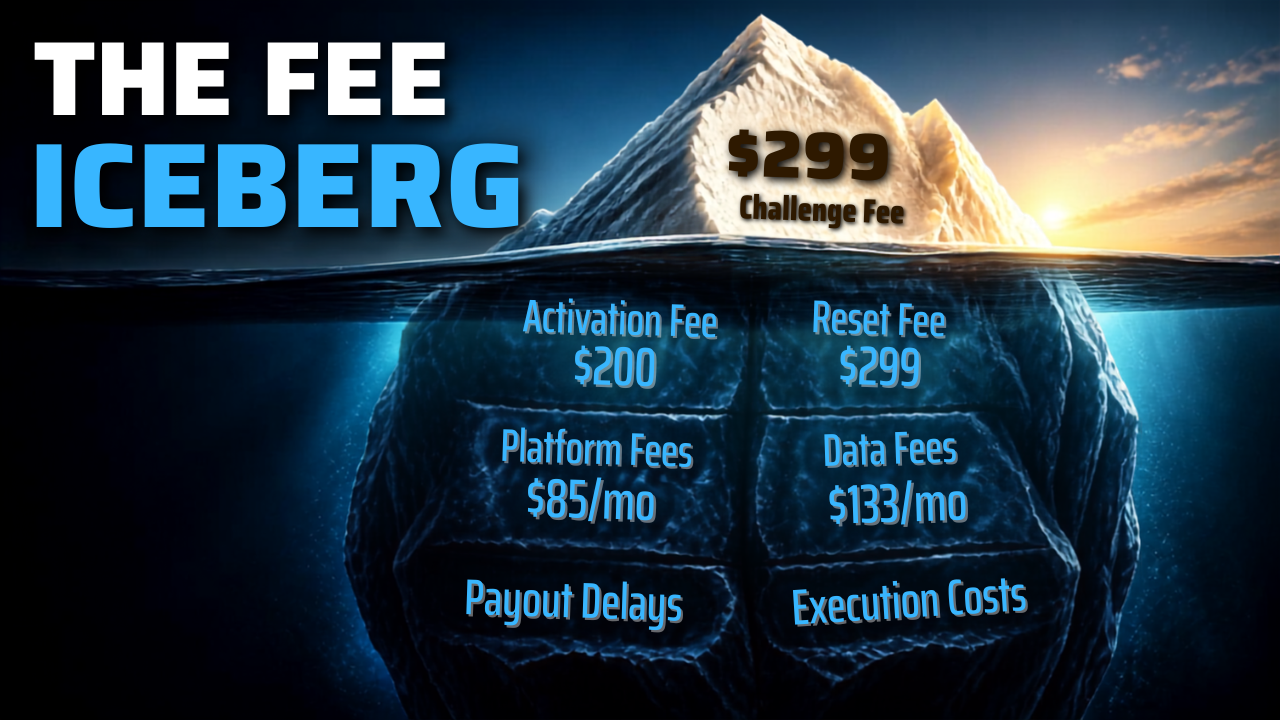
If you're evaluating a challenge-model firm, here are the costs that live below the waterline — and the questions to ask before you pay.
1. Activation Fees
You pass the challenge. You're celebrating. Then the firm tells you there's a $150-$300 fee to "activate" your funded account.
This is one of the most common hidden costs in the challenge-model industry. It hits at the exact moment you think you're done paying — after weeks or months of effort, after clearing the profit target, after proving your consistency. You're emotionally committed and financially invested. And now there's another bill.
Some firms charge zero activation fees. Others charge north of $250. The difference is pure margin for the firm, and it's almost never what traders comparison-shop for on the pricing page.
What to ask: "Are there any fees between passing the evaluation and trading a funded account?"
2. Reset Fees
With industry pass rates estimated at 10-15% on first attempts — and some analyses suggesting the number is even lower — the advertised challenge fee is almost never what most traders actually pay. If you fail once and reset, you've doubled your cost. Fail twice, tripled.
Reset fees vary widely. Some firms offer modest discounts on resets. Others charge nearly the full challenge price. A few bundle free resets into higher-tier purchases. But the math is consistent across the industry: the realistic cost of a challenge-model evaluation is the challenge fee multiplied by the number of attempts you'll actually need — and for most traders, that number is at least two.
What to ask: "If I fail the evaluation, what exactly does it cost to try again? Is the reset fee discounted? How many resets are allowed?"
3. Platform and Data Subscriptions
Some evaluations aren't one-time purchases at all. They're monthly subscriptions that bill every 30 days until you pass or cancel. Others look like one-time fees but carry mandatory monthly platform or data charges that aren't obvious at checkout.
A $49/month evaluation looks cheaper than a $500 one-time fee — until you take four months to pass. Then it's $196. Take six months? $294. And if the firm's rules are tight enough that passing quickly is unlikely, the subscription model is effectively a higher total price disguised as a lower entry barrier.
Even after funding, monthly platform fees and data subscriptions can add significant ongoing costs. In the futures space, some firms pass through CME professional data fees that run hundreds per month — a cost that's rarely mentioned on the pricing page.
What to ask: "Is the evaluation a one-time fee or a recurring subscription? Are there any monthly fees on the funded account — platform, data, software, or otherwise?"
4. Execution Costs That Eat Your Drawdown
Spreads, commissions, and slippage don't appear on any pricing page — but they're trading costs that come directly out of your account balance. In a challenge with tight drawdown limits, high execution costs don't just reduce your profits. They push you closer to breach with every trade.
A scalper paying wide spreads on a challenge account is bleeding drawdown room on every entry and exit. A swing trader paying swap fees is losing ground every night they hold a position. These costs make passing harder — and they're never factored into the advertised price.
What to ask: "What are the typical spreads, commissions, and slippage conditions on the evaluation account? Do they differ from the funded account?"
5. Payout Friction
You passed. You're funded. You're profitable. Time to get paid.
Except there's a minimum withdrawal threshold. A consistency rule. A payout review period. KYC verification. Payment processing fees. Each is a small friction point individually. Together, they can delay your first payout by weeks or months — and in some cases, reduce the amount you actually receive below what your P&L suggests.
What to ask: "What is the minimum withdrawal amount? How long does a typical payout take from request to receipt? Are there any fees deducted from payouts?"
6. The Refund Mirage
Many challenge-model firms advertise that your evaluation fee is "refunded with your first payout." This sounds reassuring. It's practically meaningless for most buyers.
If only a small single-digit percentage of evaluation buyers ever reach a first profitable payout that triggers the refund, then for the overwhelming majority, the challenge fee is a sunk cost — regardless of what the marketing says. The refund promise is structured to sound like a guarantee while applying to almost no one.
What to ask: "What percentage of traders who purchase an evaluation actually receive a fee refund? Is the refund cash or account credit?"
What a Development-Focused Prop Firm Looks Like

The alternative to the challenge-model fee labyrinth is a firm that charges transparently for what it actually provides — and makes its real money the same way you do.
In a development-focused prop firm with a profit-sharing model, the economics are simple:
- A membership or subscription fee covers access to training, coaching, mentorship, trade review, and the firm's development infrastructure. This isn't a bet on passing a test. It's tuition. You're paying for education and support — the same way you'd pay for any professional development that advances your career.
- Tiered membership levels let traders access different levels of training, capital allocation, and support based on where they are in their development. As you grow, the structure grows with you.
- Profit sharing is where the firm makes its real money. The firm takes a percentage of trading profits — and only trading profits. If you don't make money, the firm doesn't either. This is the alignment that the challenge model can't replicate.
- No activation fees, no reset fees, no challenge fees. The capital is real. The firm has already committed it. There's nothing to activate and nothing to reset — because the firm's interest is in your long-term development, not in monetizing your evaluation attempts.
The monthly subscription in this model isn't hidden. It's the point. You're paying for coaching. You're paying for mentorship. You're paying for a development structure that has been refining traders for decades. And the firm's primary revenue — the profit share — only materializes when you succeed.
That's not a fee trap. That's a partnership.
"That's not a fee trap. That's a partnership."
How to Tell Which Model You're Looking At
When you're evaluating any prop firm, cut through the marketing with three questions:
- "What am I actually paying for?"
If the answer is "the chance to take a test" — that's a challenge model. If the answer is "training, coaching, and access to a development program" — that's a development model. The former is a bet. The latter is an investment.
- "How does the firm make its primary revenue?"
If the firm earns most of its money from challenge fees, reset fees, and monthly platform charges — your success is optional to their business model. If the firm earns primarily from profit sharing — your success is their business model.
- "What happens if I struggle?"
In a challenge model, struggle means reset fees and starting over. In a development model, struggle means more coaching, more mentorship, and a structure designed to get you through the rough patches — because the firm's revenue depends on you coming out the other side profitable.
The Bottom Line
The prop trading industry in 2026 offers more options than ever — and more ways to misunderstand what you're actually paying. But the fundamental question isn't complicated: is this firm built to profit from my attempts, or from my success?
Challenge-model firms extract revenue from the evaluation process. Development-model firms invest in traders and share the upside. Both may charge fees. But what those fees represent — and whose interests they serve — couldn't be more different.
A subscription that pays for coaching, mentorship, and professional development is transparent by nature. A challenge fee that multiplies into resets, activation charges, and platform subscriptions is opaque by design. One is tuition. The other is a toll booth.
"One is tuition. The other is a toll booth."
If you're ready to explore what a real trading career looks like — one built on profit sharing, real capital, professional coaching, and a development structure that's been refining traders since 1997 — Maverick Trading has never charged a challenge fee, never charged an activation fee, and never made a dime unless its traders made one first.
Disclaimer: This content is for informational and educational purposes only. It does not constitute financial advice. Trading foreign exchange, equities, options, futures, and other financial instruments involves substantial risk of loss and is not suitable for every investor. Past performance is not indicative of future results. Fee structures and industry data referenced are based on publicly available information and third-party analysis as of mid-2026. Always verify current fees, terms, and conditions directly with any prop trading firm before making commitments.