
Jackson Hole 2026 Day One: Early Signals for September Rate Policy
Jackson Hole 2026 kicks off in one week, and the early signals on rate policy are already shaping how traders are positioning into September. This year's symposium carries more weight than most, and the data landing in the days before the opening session is giving markets their first real look at where the Federal Reserve's thinking stands heading into the next FOMC meeting. Here's what the Jackson Hole 2026 rate policy signals point to heading into day one, and how they're likely to play into the September decision.
Why This Year's Symposium Is Different
This year's gathering will be different for a simple reason: Kevin Warsh will be behind the podium as Fed Chair for the first time. He was sworn in this past May after one of the closest Chair confirmations in Federal Reserve history, and Jackson Hole 2026 will be his first real opportunity to set the tone directly with markets.
The symposium's theme, "Financial Innovation: for Payments and Policy," will put how innovations in money and payments affect central bank policy and financial stability on the agenda alongside the usual rate debate. Timing matters too. This year's event lands squarely in the run-up to the next FOMC meeting on August 27-29, with a full data cycle still to come before that decision gets made.
Key Jackson Hole 2026 Rate Policy Signals to Watch
Four themes are already shaping expectations heading into the opening session, and each one is going to matter for how the Fed talks about September.
Inflation Trajectory
Core PCE has eased toward the Fed's 2% target, but services inflation remains sticky. Fed officials are expected to weigh, publicly, whether this disinflation is durable or whether recent progress could reverse heading into the fourth quarter.
Labor Market
Payroll growth has moderated to a more sustainable pace while unemployment holds near historic lows. A labor market that's cooling without breaking gives the Fed more room to maneuver than it would have in a sharper slowdown.
"A labor market that's cooling without breaking gives the Fed more room to maneuver than it would have in a sharper slowdown."
Policy Openness
Both the Chair and several regional Fed presidents have already signaled openness to a September cut if the data cooperates. Markets are currently pricing in one 25 basis point reduction, and the language coming out of Jackson Hole next week is expected to either confirm or challenge that view.
Global Spillovers
Slowing growth in Europe and China, combined with dollar strength and commodity price volatility, is creating disinflationary tailwinds from outside the U.S. Global conditions are increasingly factoring into the Fed's risk assessment, not just domestic data.
The Macro Backdrop by the Numbers
The indicators heading into the symposium paint a mixed picture. Core PCE inflation sits at 3.3% year over year as of June, and headline CPI is running at 3.4% through July, both still elevated relative to target. Unemployment is holding stable at 4.1%, while non-farm payrolls have slowed to a 12-month average of just 34,000 per month. Second quarter GDP growth came in at 1.5% annualized, down from 2.1% in the prior quarter, enough to argue for caution but not weak enough on its own to justify an immediate cut.
That combination is the core tension the Fed is sitting with right now. Inflation hasn't fully cooperated, and growth and hiring are both losing momentum at the same time.
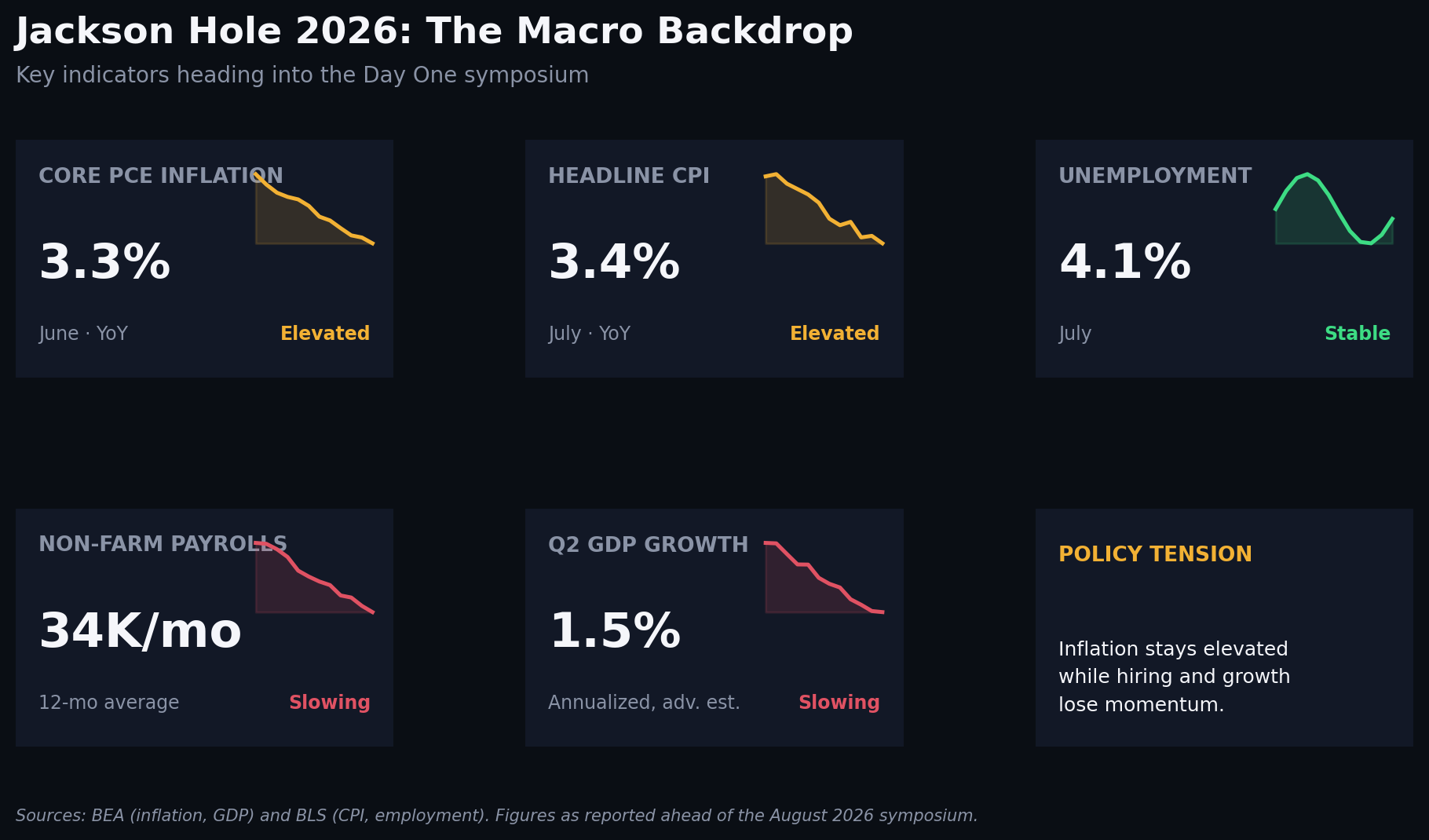
The macro backdrop heading into Jackson Hole 2026: inflation elevated, growth and hiring both slowing. Sources: BEA, BLS.
How Markets Are Likely to React
Markets won't wait for day one to start pricing this in, they rarely do. Bond yields tend to move quickly on Fed tone, and with rate-cut expectations already firming up, the 2-year Treasury is one of the first places to watch for confirmation once the symposium gets underway. Equity markets, especially rate-sensitive sectors, tend to rally hardest on improved easing prospects, while the U.S. dollar and emerging market assets often move in tandem with shifting rate expectations.
That kind of real-time repricing is worth watching closely once the symposium starts, because it tells you where the crowd's expectations are shifting before the Fed ever confirms anything officially. A retreating 2-year yield would signal the bond market pricing in a higher probability of a cut. A rally concentrated in rate-sensitive sectors, rather than a broad-based move across the whole index, would tell you which parts of the market are most levered to the outcome. Watching where the reaction is concentrated is often more useful than watching the headline number itself.
"Watching where the reaction is concentrated is often more useful than watching the headline number itself."
None of that means a move, once it happens, is finished, or that positioning ahead of a headline comes without risk. Fast, single-day reactions are exactly the environment where How Professional Traders Manage Risk matters most, since a headline that moves the market on day one can just as easily reverse over day two or three of the symposium. Chasing the first candle after a Fed-related headline is one of the more common ways traders give back gains they never should have been swinging for in the first place.
"Chasing the first candle after a Fed-related headline is one of the more common ways traders give back gains they never should have been swinging for in the first place."
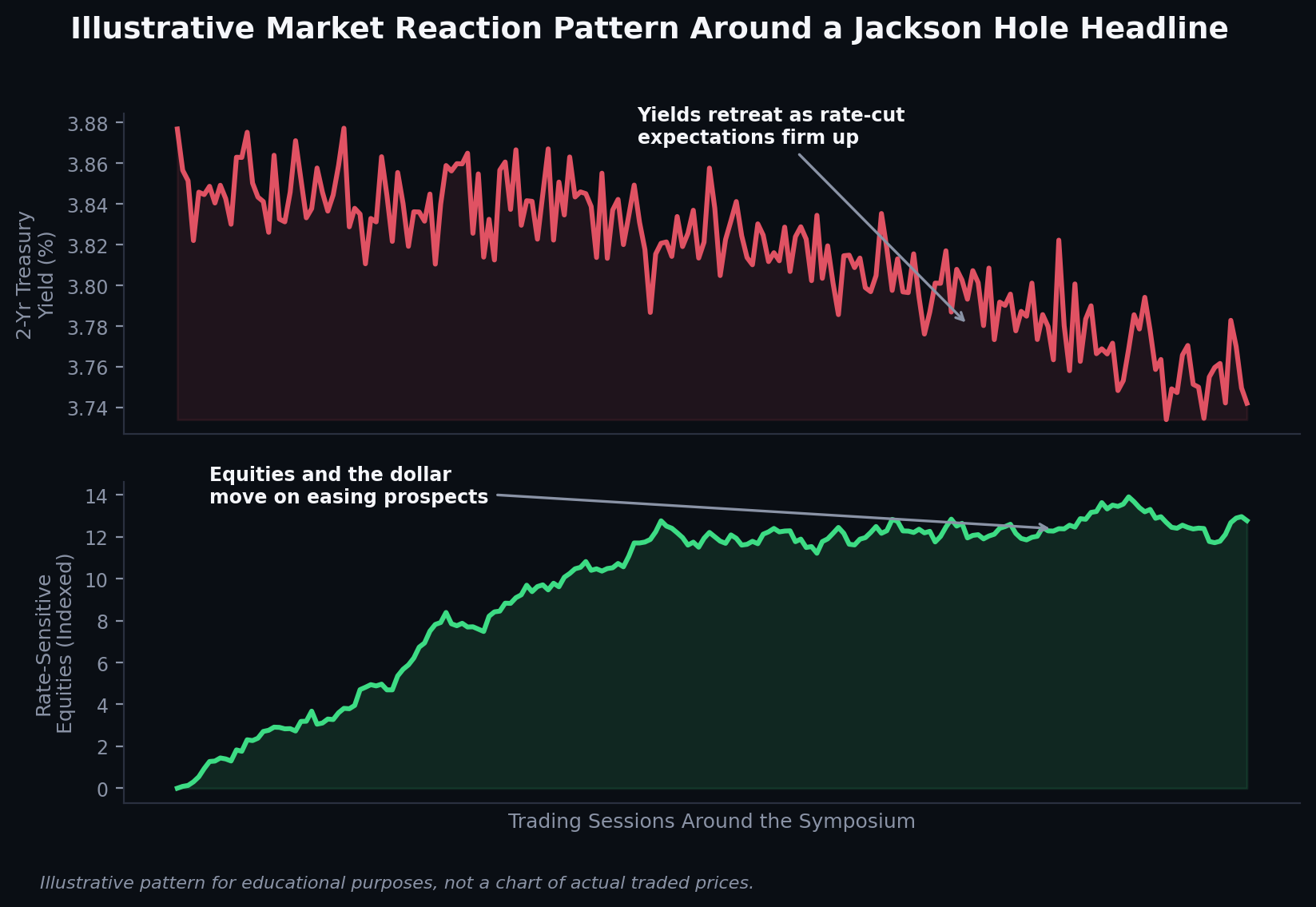
Illustrative pattern of how yields and rate-sensitive equities have tended to move around Jackson Hole headlines. Not a chart of actual traded prices.
Three Paths for the September Decision
Markets are watching closely for how the Fed's September decision will shake out, and three distinct pathways are already on the table heading into the symposium.
Path 1: Hold
Persistent services inflation and resilient labor data give the Fed cover to pause, reinforcing a "higher for longer" posture into the fourth quarter of 2026.
Path 2: Cut 25 Basis Points
Softening CPI trends and cooling wage growth open a narrow window for a modest easing move, one that would be framed as a recalibration rather than a full pivot.
Path 3: Accelerate Easing
A sharper-than-expected deterioration in the labor market could prompt a 50 basis point move, though Fed officials have signaled this remains a low-probability scenario.
Consensus heading into the symposium leans toward a data-dependent hold, with September serving as a critical inflection point for the rest of the 2026 easing cycle.
What This Means for Your Trading
Headline days move fast once they hit, and the temptation will be to chase whatever direction the market breaks in the first few hours of the symposium. That instinct usually isn't the right one. The signals heading into day one are meaningful, but they're also just the setup for a three-day symposium, and Fed officials will have two more days after the opening session to add nuance, walk something back, or reinforce what's already been said. A single soundbite pulled out of a 45-minute address is rarely the full picture, and the traders who get burned around events like this are usually the ones who treat the opening headline as the final word.
This is also where Understanding Market Psychology becomes useful, because the crowd's read on a single day's headline rarely matches where the data actually ends up settling. Sentiment tends to overshoot in both directions before it settles somewhere closer to the fundamentals, and Jackson Hole is a textbook setup for exactly that pattern. Traders who wait for confirmation across the full symposium, rather than reacting to the first soundbite, tend to be the ones still standing when the September decision actually lands.
That kind of patience isn't just a mindset, it's a skill that gets built through structure, mentorship, and repetition, the same way any other professional discipline does. Reacting to headlines is easy. Building a process that holds up across a full news cycle, and across a full career, is what separates traders who last from traders who don't.
Jackson Hole is one week out, and the September rate decision is still weeks beyond that. What you do with your capital between now and then is worth thinking through carefully, and it starts with understanding what a real trading career looks like.