
Prop Trading Macro Events: Why Real Capital Changes the Calculus
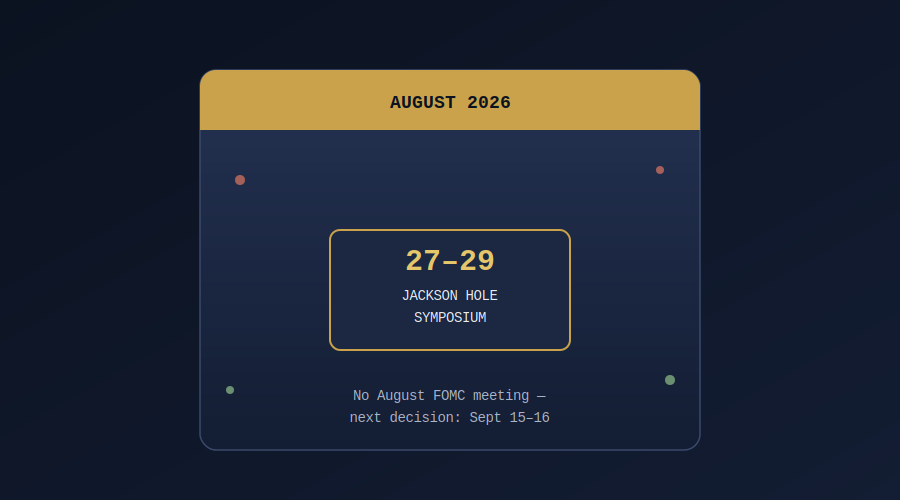
Central bankers, policymakers, and academics from more than 70 countries convene in Jackson Hole, Wyoming, from August 27 to 29 for the Federal Reserve Bank of Kansas City's annual Economic Policy Symposium — and for anyone tracking prop trading macro events, this is the one that sets the tone for the rest of the year. This year's theme, "Financial Innovation: Implications for Payments and Policy," centers on the systems moving money — but it's the Friday keynote that traders will actually be positioned for. With no Fed meeting scheduled for August, Jackson Hole carries the full weight of shaping expectations heading into the September decision, and a single line from the podium has moved markets by a full percent or more in years past.
For most retail traders, an event like this is simply something to watch. For traders operating inside a prop trading firm, it's something the account structure itself forces them to think about — because not every funded trading model handles macro-event risk the same way.
Two Very Different Ways to Sit Through the Same Speech
Picture two traders watching the same keynote address. Both have solid setups. Both understand the macro backdrop. Both are right about the direction the market moves.
The Challenge-Model Account
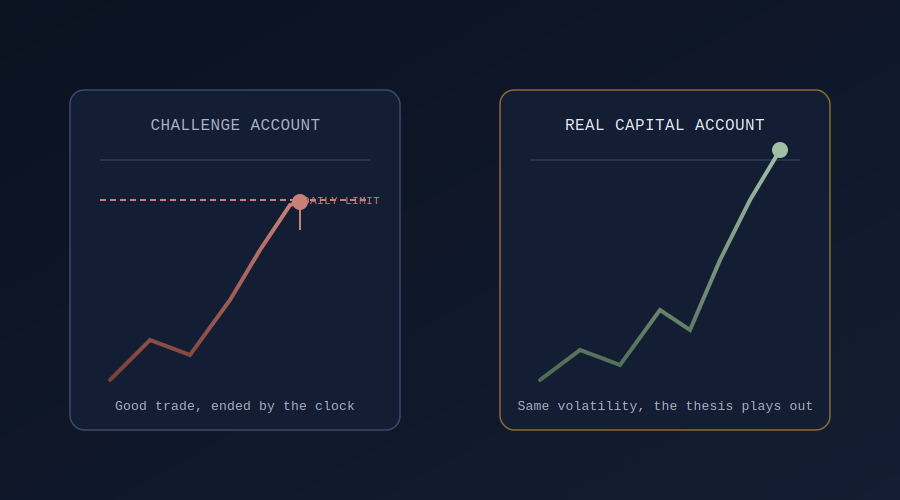
The first trader is on a challenge-model account, capped by a fixed daily loss limit that resets at midnight regardless of what the market is doing. A sharp, fast move against their position before it turns in their favor — the kind of whipsaw that's common in the minutes after a high-profile speech — can trip that daily limit and end the account before the trade ever has a chance to work.
The Real-Capital Account
The second trader is working with a firm's real capital, inside a structure built around sustained performance rather than a single bad session. The same whipsaw is still uncomfortable, but it doesn't automatically end anything. The trader can manage the position, size appropriately, and let the original thesis play out.
Same market. Same read. Two completely different outcomes — and the difference had nothing to do with trading skill.
Why Account Structure Matters More During Macro Events Specifically
Most trading days don't test the edges of an account's rules. Macro events do, by design. A Jackson Hole keynote, a surprise line from a Fed chair, or unscheduled headlines around a policy shift are exactly the moments when price can move further and faster than a normal session — which means they're also exactly the moments when a rigid, fixed-drawdown structure is most likely to remove a trader from the game at the worst possible time.
This isn't a hypothetical. It's the recurring pattern behind the business model behind proprietary trading firms: firms built around pass/fail challenge accounts generate revenue in part from traders who don't survive volatile stretches, which creates a structural incentive to keep the rules tight even when tight rules work against traders during the market's most important moments. A firm trading its own real capital alongside its traders has the opposite incentive — it wants traders to survive the volatile stretch and keep performing, because that's how the firm makes money too.
A firm trading its own real capital alongside its traders has the opposite incentive — it wants traders to survive the volatile stretch and keep performing, because that's how the firm makes money too.
That distinction is easy to miss when comparing headline offers side by side. It only becomes visible in exactly the kind of week Jackson Hole represents.
What "Real Capital" Actually Changes for Prop Traders
Trading a firm's real capital, instead of a simulated challenge balance, changes the calculus in a few concrete ways during a high-volatility macro week:
Risk Tolerance Reflects the Account, Not a Countdown Clock
Risk tolerance reflects the account, not a countdown clock. A trader isn't managing risk against an arbitrary daily reset. They're managing risk the way a professional actually should — around the trade and the broader account performance over time.
One Volatile Session Doesn't Erase Weeks of Good Decisions
A single volatile session doesn't erase weeks of good decisions. Challenge accounts are frequently structured so that one outsized adverse move can undo everything leading up to it. A performance-based capital model absorbs a rough session as part of a longer track record, not as a pass/fail event.
Position Sizing Becomes a Trading Decision, Not a Survival Tactic
Position sizing decisions get made for trading reasons, not survival reasons. When an account isn't one bad print away from ending, sizing down ahead of a keynote is a risk-management choice rather than a defensive necessity forced by the account's rules.
Capital Scales With Performance, Not With Passing a Single Test
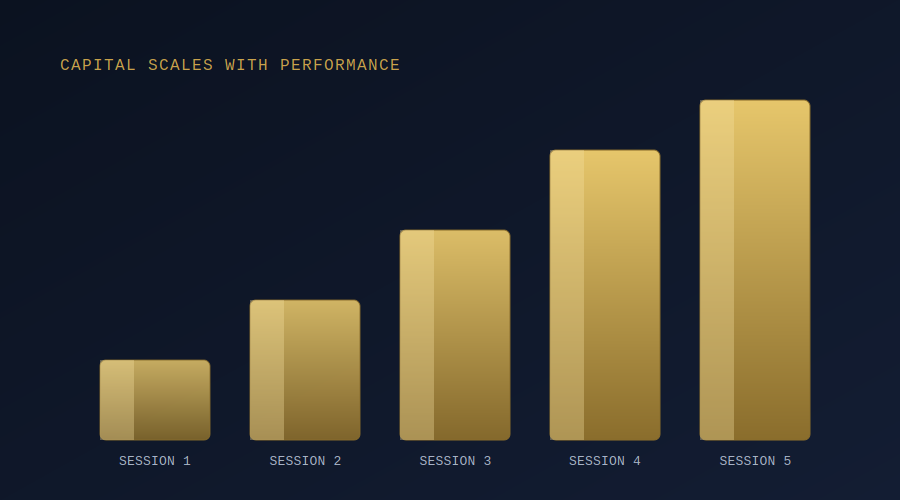
Capital scales with demonstrated performance, not with surviving a single test. Traders who navigate volatile macro weeks well are positioned to grow their capital allocation over time — the account structure rewards the behavior that produces good long-term outcomes.
None of this means real-capital accounts eliminate risk. Macro events are still genuinely risky, and no account structure changes what the market does. What changes is whether a trader's own account rules become an additional source of risk layered on top of the market's — and during a week like Jackson Hole, that layered risk is exactly what trips up traders who would otherwise have made the right call.
What This Looks Like Heading Into August 27–29
Markets already know a keynote is coming. What they don't know is what gets said, and history offers a reminder of how much a single Jackson Hole address can move: last year's speech shifted rate-cut odds by double digits within the same session and sent major indices up sharply within hours. Whether this year's remarks land as market-moving or comparatively quiet won't be clear until the room goes live — which is precisely why the structure a trader is operating under matters more heading into the event than any single prediction about what gets said.
Traders evaluating how to evaluate any funded trading program often focus first on profit splits or account sizes, and those numbers matter. But a week like Jackson Hole is a useful stress test for a question that's easy to overlook until it's too late: does this account structure let good trading decisions play out, or does it punish exactly the kind of short-term volatility that a solid macro thesis has to survive on the way to being right?
The Bottom Line
Macro events aren't going away, and traders can't control what a Fed chair says from a podium in Wyoming. What traders can control is the structure they're trading inside of when that speech happens — whether a fixed daily rule is working against a sound thesis, or whether the account is built to let a well-managed position see it through.
That's the real difference between trading a challenge and trading real capital: not the headline profit split, but what happens to a good trade when the market gets loud.
Ready to see how a real-capital account handles the moments that matter most? Explore what a real trading career looks like with Maverick Trading.