
Sector Rotation Strategy: How to Spot the Move Before It Happens
Sector rotation isn't a mystery. It leads the business cycle, it repeats across market history, and it leaves a trail long before the crowd notices. The problem is most traders never learn to read that trail. They wait for confirmation that's already public, which means they're buying after the move has largely happened.
This article breaks down a sector rotation strategy explained the way we teach it inside Maverick Trading: how institutional money rotates first, what signals show up before the media picks up the story, and how to build a checklist that puts you in position early instead of chasing a trend that's already extended.
Most Traders Are Already Late

Here's the sequence that plays out every single rotation cycle, and it happens in three stages.
First, institutions move. Smart money rotates quietly. Volume builds inside a sector while relative strength starts shifting, long before anyone is talking about it. Second, analysts confirm. Sector upgrades start appearing. Financial media picks up the story, and suddenly everyone's talking about the same trade. Third, retail enters late. Most traders buy in after the biggest part of the move is already done, which is exactly why so many rotation trades feel disappointing even when the underlying thesis was correct.
The edge is simple to state and hard to execute. Rotation signals appear weeks before the mainstream trade becomes obvious. A structured framework identifies institutional footprints early, before the crowd confirms what's already happened.
"Understanding where we are in the rotation gives you the when to act."
Sector Rotation Strategy Explained: Sector Performance Across the Business Cycle
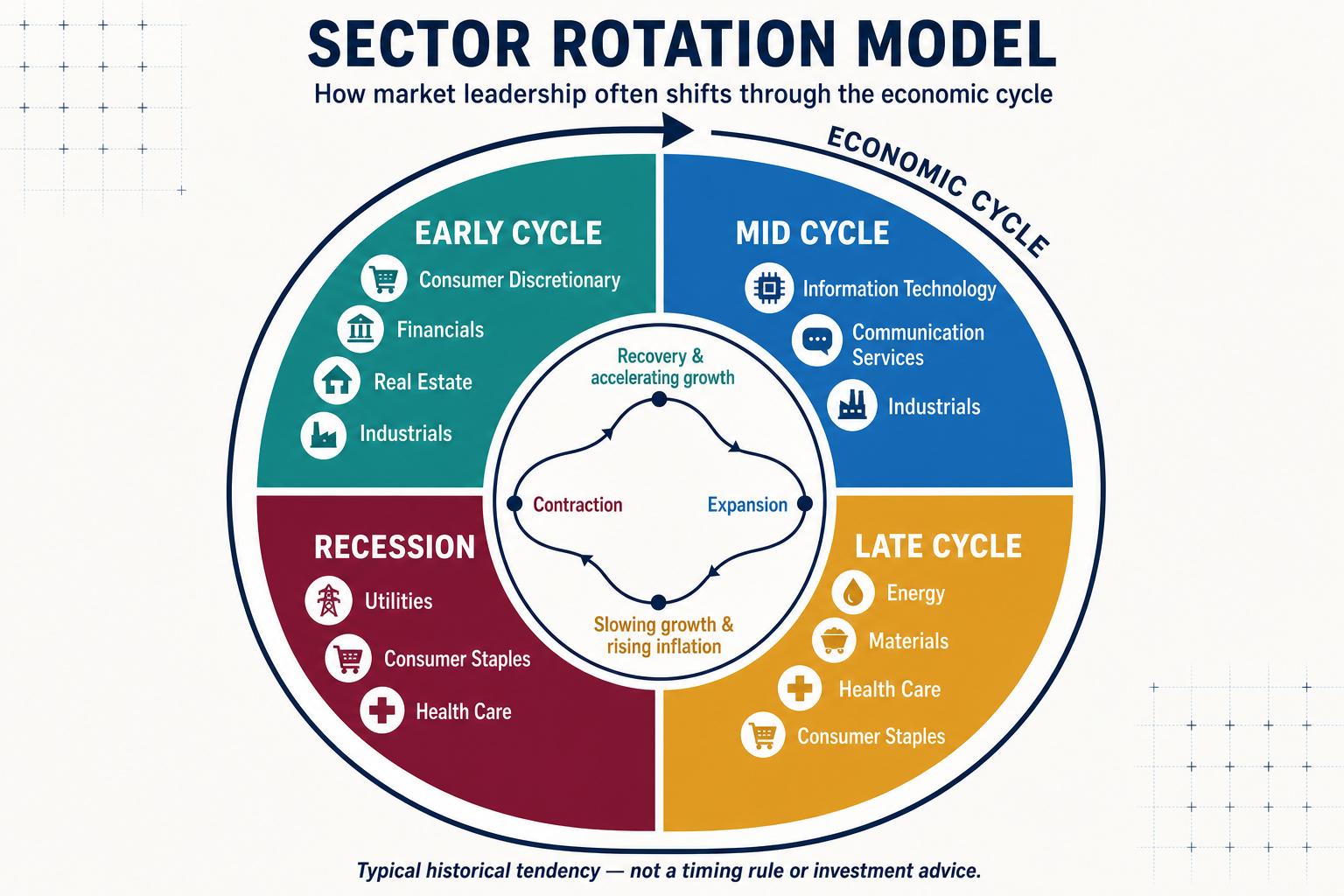
Sectors don't move at random. They lead and lag in a fairly consistent order tied to where the economy sits in its cycle, which is why sector thinking beats stock picking when you're trying to time entries around a macro theme instead of a single company's earnings report.
Early Cycle (Recovery Begins, Credit Loosens)
Financials, Consumer Discretionary, and Industrials tend to lead as rate cuts and looser credit conditions favor rate-sensitive and cyclical names.
Mid Cycle (Growth Accelerates, Earnings Rise)
Technology, Industrials, and Materials typically take over as economic growth broadens out and corporate earnings climb.
Late Cycle (Inflation Rises, Growth Peaks)
Energy, Materials, and Healthcare usually start to lead as inflation pressures build and growth begins to top out.
Recession (Defensive Posture, Safety Plays)
Utilities, Consumer Staples, and Healthcare hold up best as capital rotates into defensive, non-cyclical names.
None of this is guaranteed to play out on a fixed schedule. But the pattern is repeatable enough that knowing which phase you're likely in tells you which sectors deserve your watch list attention right now.
4 Early Warning Signals to Watch
This is where the framework becomes actionable. There are four signals that consistently show up before a sector rotation is confirmed by price alone.
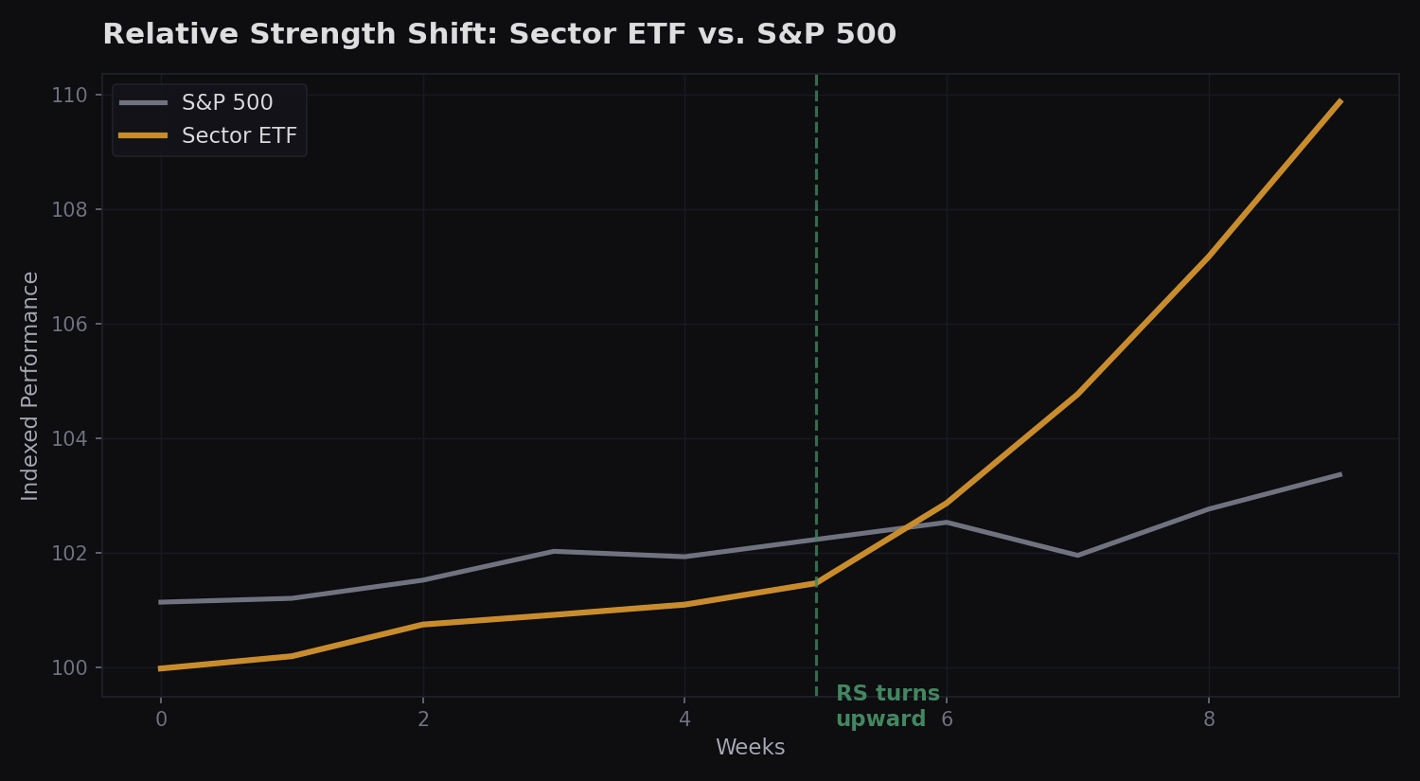
1. Relative Strength Shift. A sector ETF outperforming the S&P 500 on a 4 to 6-week rolling basis is the first alert. When relative strength turns from flat to upward sloping, that's your earliest tell. For more on this, see what sector strength really means.
2. Volume Expansion. Watch for increasing volume on up days within the sector paired with declining volume on pullbacks. That combination is the classic signature of institutional accumulation, and it tends to show up before price breaks out.
3. Internal Breadth Improvement. More stocks within the sector making new highs is a quiet but powerful tell. Breadth typically expands before the sector ETF price fully confirms the move, which means you can see the shift building under the surface.
4. Intermarket Confirmation. Bonds, commodities, or FX moving in alignment adds another layer of evidence. Rising yields supporting Financials or rising crude supporting Energy are the kind of cross-asset confirmations that strengthen your conviction on a rotation thesis.
"When two or more of these signals line up at the same time, you're looking at a rotation that has real institutional participation behind it, not just a one-day pop."
Build Your Pre-Rotation Entry Plan
Turning the signals above into action requires a checklist, because waiting for a feeling of conviction is how traders talk themselves into being early or late instead of on time.
1. Identify the cycle phase. Use the framework above to narrow down which sectors should be leading right now.
2. Rank sectors by relative strength. Pull up a sector performance screener and sort by 1 week, 1 month, and 3 month performance to see which sectors are actually leading.
3. Confirm with volume and breadth. Check that the move has real participation behind it, not just a handful of large-cap names carrying the sector.
4. Find the leading stocks. Once a sector is confirmed, identify the individual names showing the strongest relative strength within that group.
5. Size for the trend, not the trade. Position sizing should reflect how much conviction the signals actually support, not how exciting the setup feels.
How to Position Before the Crowd
Once your watch list is built, execution happens in three phases.
Scout
This is where you build the watch list: identify your top three RS sectors, review the sector ETF chart, list stock candidates within those sectors, and set RS alerts so you're notified the moment conditions change.
Entry
Take the initial position at 50% of your planned size, entered near the sector ETF breakout level. Place your stop below the base and document your thesis before you place the trade, not after.
Manage
Confirm and add the second half of your position once volume expands, price moves above prior highs, and breadth continues to improve. Once the trade is working, raise your stop to breakeven to protect the position.
Risk management ties the whole plan together. Never risk more than 1 to 2% of your portfolio on any single sector rotation trade. Sizing decisions like this one connect directly back to how you handle capital allocation across your whole account, not just within a single trade.
Key Takeaways
Rotation leads the business cycle. It's a predictable, repeatable pattern that shows up across market history, not a random walk.
The signal precedes the consensus. Relative strength, volume, and breadth shift weeks before the media catches on to the story.
Your checklist is your edge. A systematic process removes emotion from sector selection and keeps you from chasing headlines.
Position early, add on confirmation, and manage to the sector trend, not to daily news flow. That discipline is what separates traders who catch rotations early from those who are still buying after the move is already priced in.
"Position early, add on confirmation, and manage to the sector trend, not to daily news flow."
Traders who are serious about making this a career explore what it looks like to trade with firm backing.