
Why August Is the Most Dangerous Month for Complacent Traders
The August Illusion: Why Calm Markets Hide Real Danger
Ask most traders which month scares them and you'll hear March, October, maybe January. August rarely makes the list. Trading desks thin out, volume charts flatten, and the financial media shifts to summer-rerun mode. It feels like the market is on vacation.
That feeling is exactly the problem.
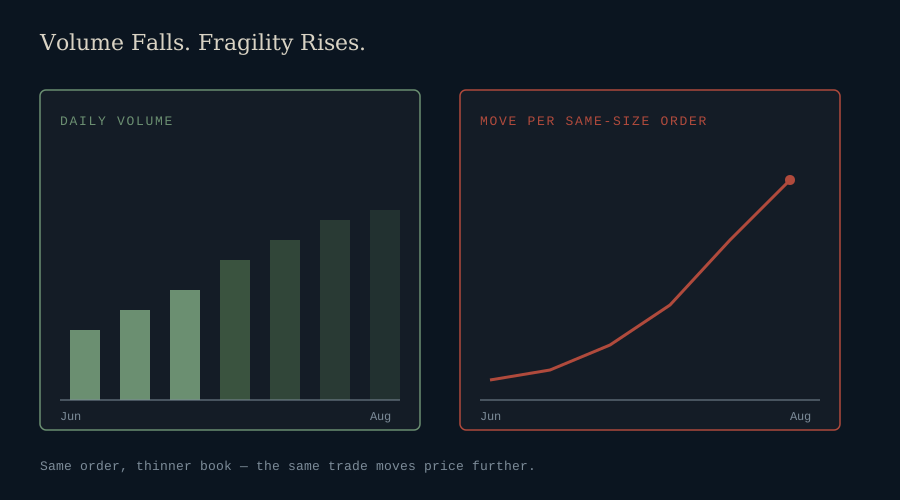
August has quietly produced some of the sharpest, least-forecast drawdowns in modern market history — not despite the calm, but because of it. The danger was never the low volume itself. Low volume is a structural fact of the calendar, not a threat on its own. The real danger is what low volume does to traders: it lowers their guard at precisely the moment the market has the least capacity to absorb a shock.
The Liquidity Illusion in Thin August Markets
Liquidity is what lets large orders move through a market without violently moving the price. In a normal, well-populated market, a big sell order gets absorbed by a deep pool of resting buy orders on the other side. In August, that pool shrinks. Institutional desks reduce staffing, algorithmic market-makers often narrow their risk appetite, and overall participation drops across equities, currencies, and futures.
None of that is inherently dangerous — it's just thinner. The danger shows up when a piece of unexpected news, a data surprise, or a large institutional order arrives into that thinner market. With fewer participants absorbing the move, price can gap and swing far more violently than the same event would produce in a more liquid month. A trade that would have moved a market half a percent in June can move it two or three percent in August, purely because there's less on the other side of the trade to slow it down.
This is the liquidity illusion: quiet price action gets mistaken for a quiet market, when what's actually quiet is participation. The moment participation returns — often abruptly — volatility returns with it.
Why Traders Get Caught Off Guard in Low-Volume Months
Traders who manage risk well in high-volume months sometimes let that discipline slip in August. Position sizes creep up because "nothing's moving anyway." Stop-losses get widened because "there's no reason for a big swing right now." Attention drifts because the charts look boring on a Tuesday afternoon in the third week of the month.
This is where the real risk lives — not in the market structure, but in the trader's own behavior. Firms that manage risk at scale don't relax their frameworks based on the calendar; they apply the same position-sizing and exposure limits in August that they apply in any other month, precisely because they know volatility doesn't respect the season. You can see how this plays out in practice in How Firms Manage Risk at Scale, where consistent, rules-based risk management is what separates traders who survive a surprise move from traders who get wiped out by one.
The pattern is almost always the same: a trader who has been disciplined all year treats August as an exception, loosens their process for a few weeks, and is unprepared when the market snaps back to life.
The Historical Track Record of August Market Shocks
August's reputation for producing outsized surprises isn't anecdotal — it shows up repeatedly across market history. The common thread in nearly every major August disruption is the same: a market operating with reduced participation gets hit with a shock it doesn't have the depth to absorb smoothly, and the resulting move is amplified far beyond what the underlying news would justify in a more liquid month.
Traders who lived through these periods often describe the same experience: weeks of drifting, low-conviction price action followed by a handful of days where the market moves more than it had in the previous month combined. In several notable cases, the news event that triggered the move wasn't even historically unusual — a data release, a policy comment, an overseas market decline. What made the reaction outsized was the market's reduced ability to absorb it, not the size of the news itself.
That distinction matters for how a trader should think about risk. It's tempting to treat these episodes as rare, once-a-decade anomalies. In reality, some version of an August liquidity surprise shows up often enough that it deserves to be treated as a recurring seasonal risk, not a black-swan outlier. The lesson isn't that August is cursed. It's that thin markets are structurally more fragile, and fragile markets are where complacency gets punished hardest.
Complacency, Not Volume, Is the Real Risk
This is the point worth sitting with: low volume is not the enemy. Low volume is a known, predictable, recurring feature of the summer calendar. Complacency is the enemy, and complacency is a choice — or more precisely, a drift that happens when a trader stops treating risk management as a constant and starts treating it as something that flexes with how exciting the market feels.
Complacency is the enemy, and complacency is a choice
Emotional discipline is what keeps that drift from happening. It's easy to stay sharp when the market is moving and adrenaline is doing some of the work for you. It's much harder to stay sharp when nothing has happened in six trading sessions and every instinct says the current calm will continue. That instinct is exactly what needs to be managed, and it's a core theme in Emotional Control in Trading — the traders who hold their process together during the boring stretches are the ones who aren't scrambling when the boring stretch ends.
Complacency shows up in small, almost invisible decisions: skipping the pre-market check because "there's nothing to check," ignoring a widened bid-ask spread because the trade "felt fine yesterday," or assuming a level will hold simply because it's held for two quiet weeks. Individually, each of these looks harmless. Stacked together, they leave a trader fully exposed the moment the market decides August isn't going to stay quiet after all.
How Disciplined Traders Actually Treat August
Traders who navigate August well aren't the ones predicting the exact day volatility returns — nobody can consistently do that. They're the ones who keep the same process running regardless of how sleepy the tape looks. In practice, that means a few consistent habits:
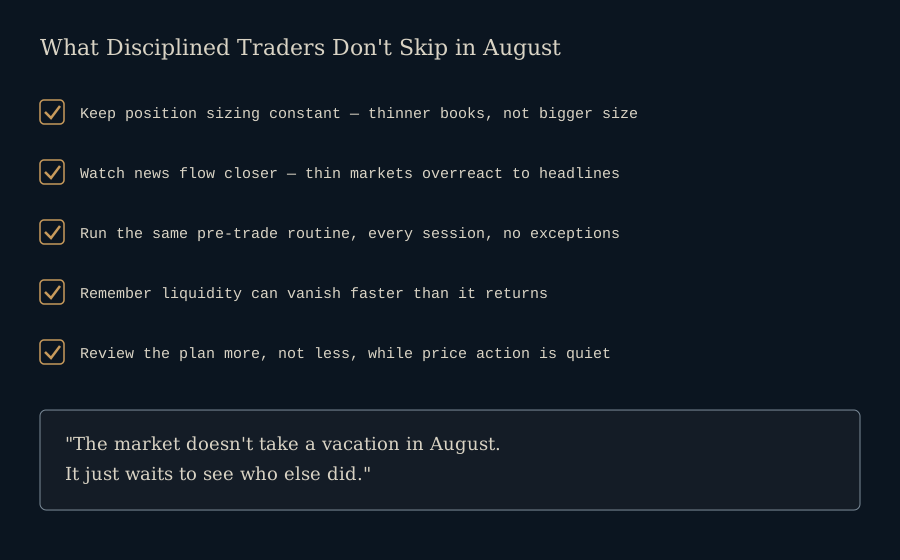
Keep Position Sizing Constant
They keep position sizing constant. Reduced liquidity is a reason to size down, not up, since the same dollar exposure now carries more slippage risk on both entry and exit.
Widen Attention to News Flow, Not Stop-Losses
They widen their attention to news flow, not their stop-losses. Thin markets react more, not less, to headlines — economic data, central bank commentary, and geopolitical developments can move a quiet market further than they'd move a busy one.
Stick to the Same Pre-Trade Routine
They treat every session with the same pre-trade routine. The traders who get hurt in August are almost never the ones who kept doing the boring, repeatable checklist. They're the ones who decided the checklist could wait until things got interesting again.
Remember Liquidity Can Vanish Fast
They remember that liquidity can vanish faster than it returns. A market can go from thin-and-quiet to thin-and-violent in a single session, because the same lack of depth that made it quiet also makes it unable to cushion a sudden move in either direction.
Review the Plan More Often, Not Less
They review their plan more often, not less. When price action is quiet, it's easy to assume there's nothing new to evaluate. Disciplined traders use quiet stretches to revisit their thesis, confirm their risk parameters still make sense, and prepare for the range of scenarios that could unfold when volatility does return — rather than waiting to react after it already has.
None of this requires predicting the future. It requires refusing to let the calendar dictate how seriously risk gets taken.
The Bigger Picture: August as a Discipline Stress Test
August is a useful stress test, not because it's uniquely dangerous in itself, but because it reveals which traders actually have a repeatable process and which traders have been relying on market momentum to paper over gaps in their discipline. A trader with a real process treats a slow August exactly like a fast October: same risk limits, same review habits, same respect for the fact that markets can move without warning.
That kind of consistency isn't built by accident, and it isn't built in a single month. It's built through structured experience, real capital, and a framework that doesn't bend just because the tape looks calm. If you're curious about what a real trading career looks like — one built on that kind of consistency rather than on guessing which weeks the market will decide to matter — that's exactly the environment a funded trading program is meant to provide.
The market doesn't take a vacation in August. It just waits to see who else did.