
Why Risk/Reward Matters More Than Win Rate
Many new traders become obsessed with one statistic: win rate.
It's easy to understand why. Winning 70% or 80% of your trades sounds like the perfect recipe for success. Unfortunately, that's one of the biggest misconceptions in trading.
Professional traders know that risk/reward is far more important than simply winning often. A trader with a lower win rate can outperform someone with an extremely high win rate if they consistently manage risk and allow profitable trades to outweigh their losses.
"A trader with a lower win rate can outperform someone with an extremely high win rate if they consistently manage risk and allow profitable trades to outweigh their losses."
Understanding the relationship between risk/reward and win rate is one of the biggest steps toward becoming consistently profitable.
The Problem with Chasing a High Win Rate
Winning feels good.
Taking losses doesn't.
Because of this, many traders unconsciously begin making decisions that improve their win rate while actually hurting long-term profitability.
Common examples include:
- Taking profits too early
- Refusing to cut losing trades
- Moving stop losses farther away
- Holding losing positions hoping they'll recover
These habits often create an attractive win percentage while quietly increasing the size of losing trades.
Eventually, one large loss wipes out weeks, or even months, of small gains.
What Is Risk/Reward?
Risk/reward compares how much you're willing to lose if a trade fails versus how much you expect to make if it succeeds.
For example:
- Risk $100 to make $100 = 1:1
- Risk $100 to make $200 = 1:2
- Risk $100 to make $300 = 1:3
Professional traders don't expect every trade to win.
Instead, they focus on making sure that winning trades are large enough to offset inevitable losing trades.
That's the foundation of long-term consistency.
Why Win Rate Alone Doesn't Tell the Story
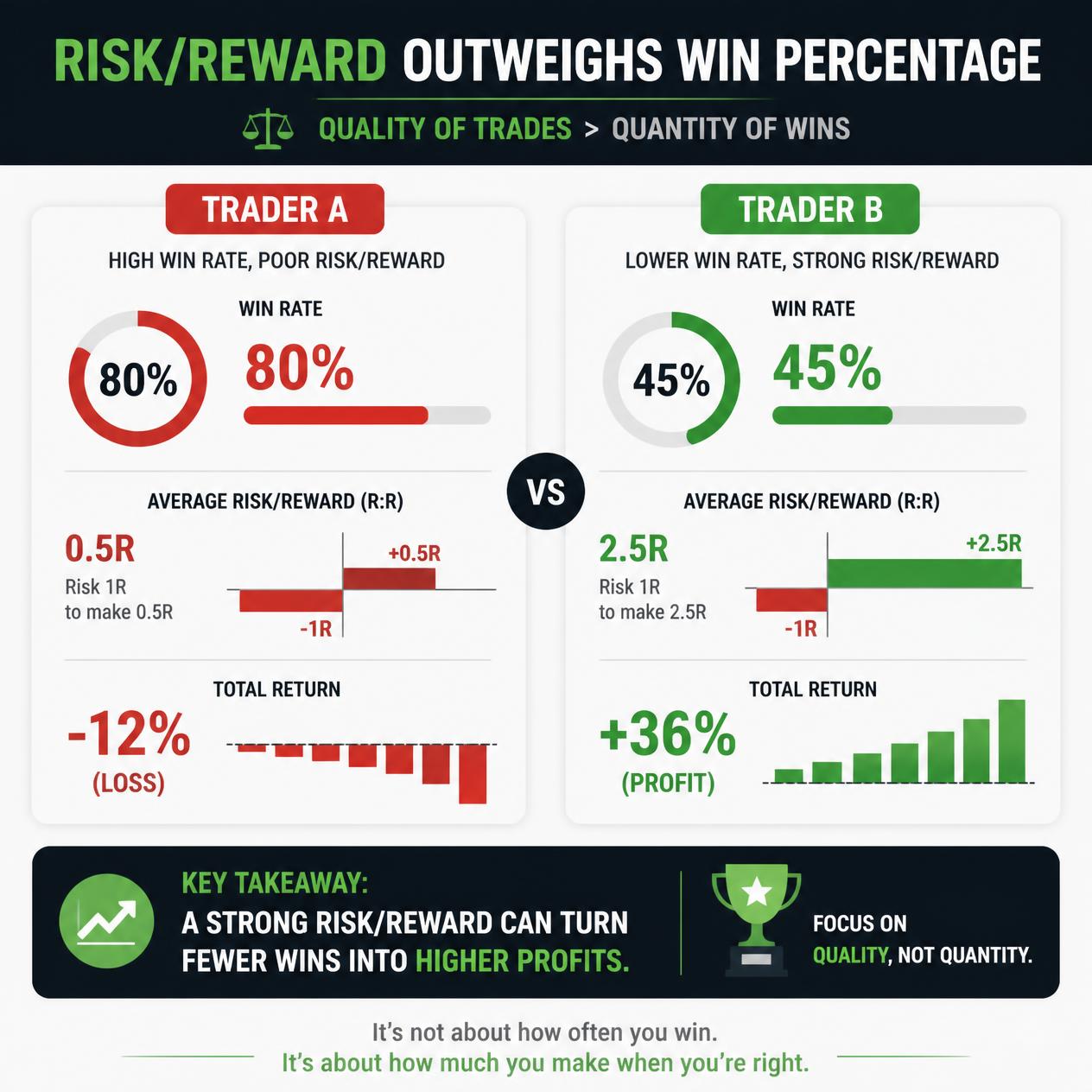
Imagine two traders.
Trader A
- Wins 80% of trades
- Makes $100 on winners
- Loses $500 on losers
After 10 trades:
- 8 winners = +$800
- 2 losers = -$1,000
Net Result: -$200
"Despite winning most of the time, Trader A loses money."
Trader B
- Wins only 45% of trades
- Makes $300 on winners
- Loses $100 on losers
After 10 trades:
- 4.5 winners = +$1,350
- 5.5 losers = -$550
Net Result: +$800
"Trader B loses more often but makes significantly more money."
This simple example shows why experienced traders evaluate both probability and payoff, not just win percentage.
The Math Behind Professional Trading
Every trading strategy has an expected value.
Expected value measures whether a strategy is profitable over hundreds of trades rather than judging individual outcomes.
The formula is simple:
Expected Value = (Win Rate × Average Winner) − (Loss Rate × Average Loser)
This explains why many successful traders can remain profitable while winning fewer than half of their trades.
They're simply making more when they're right than they lose when they're wrong.
Why Risk Management Creates Consistency
Professional traders don't try to predict every market move.
Instead, they manage uncertainty.
Markets are unpredictable.
Even the best technical setups fail.
That's why professionals determine their maximum risk before entering every trade.
Good risk management means:
- Knowing your stop loss before entry
- Defining realistic profit targets
- Keeping position sizes consistent
- Avoiding emotional decision-making
These habits help keep losses small while allowing winners room to develop.
For a deeper look at professional risk techniques, read How Professional Traders Manage Risk.
Your Trading Plan Should Define Risk
A trading plan shouldn't simply identify entries.
It should answer important questions before every trade:
- How much capital will you risk?
- Where will you exit if you're wrong?
- What reward justifies taking the trade?
- Does the setup meet your minimum risk/reward requirement?
Many professional traders avoid setups that don't offer at least a 2:1 reward relative to their risk.
This doesn't guarantee profits.
It simply ensures that over many trades, profitable opportunities have the potential to outweigh losses.
Your trading plan becomes the framework that removes emotional decisions from the process.
Learn more about building that framework in The Role of a Trading Plan.
Emotional Trading Often Destroys Risk/Reward
Poor emotions typically produce poor risk/reward.
Fear causes traders to:
- Exit winners too early
- Skip high-quality setups
- Take profits before targets are reached
Hope causes traders to:
- Hold losing trades
- Ignore stop losses
- Add to losing positions
Professional traders understand that protecting capital is their first priority.
Once risk is controlled, profitability becomes much more repeatable.
Structured Trading Improves Decision Making
Many independent traders struggle because every decision feels personal.
Without structure, it's easy to:
- Change rules mid-trade
- Increase position size after losses
- Ignore risk limits
- Trade emotionally
This is where trading within a structured trading environment can begin making a meaningful difference over time.
Clear risk parameters, consistent processes, accountability, and ongoing education encourage disciplined decision-making rather than emotional reactions.
While no environment can eliminate losses, having established risk standards often helps traders focus on executing their plan instead of chasing short-term results.
Focus on Long-Term Performance
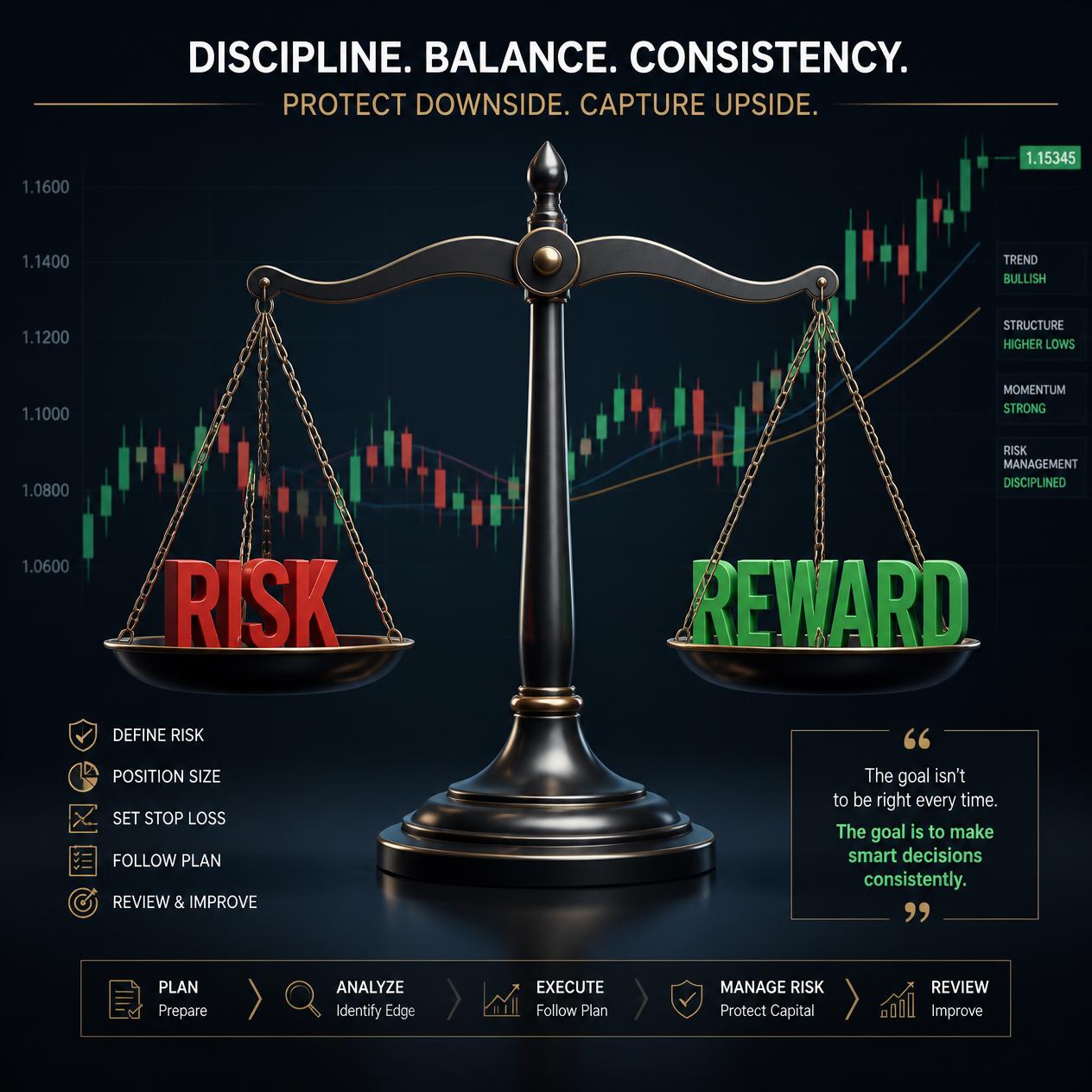
The goal isn't winning every trade.
The goal is to build a process that performs over hundreds of trades.
Professional traders understand that:
- Small losses are normal.
- Large losses are avoidable.
- Consistent risk management creates consistency.
- Risk/reward drives long-term profitability.
Once traders stop measuring success by today's win rate and start measuring the quality of their decisions, their performance often becomes far more consistent.
Many beginning traders spend years trying to increase their win percentage while overlooking the factor that matters most: risk/reward.
A balanced approach to risk management allows losing trades to remain manageable while giving winning trades enough room to produce meaningful gains over time.
When combined with a disciplined trading plan and consistent execution, strong risk/reward principles become one of the most powerful advantages a trader can develop.
If you're looking to improve your consistency, working within a structured trading environment can provide the discipline, education, and risk management framework that many traders find difficult to maintain on their own.