
High Volatility Trading Strategies: 3 Ways to Manage Risk
By Rob Reinhold, Maverick Trading
High volatility trading strategies start with adjusting risk to the market in front of you. Your trading strategy has been working. You’re finding entries, managing your stops, and putting together some good trades.
Then the market changes.
Suddenly, you’re getting stopped out. You buy a stock, it drops through your stop, and then it turns around and goes exactly where you thought it would. You try again, and the same thing happens.
It’s easy to look at that and say, “Boy, I can’t seem to trade anymore.”
But before you throw out your entire strategy, look at the environment you’re trading in. If volatility has increased substantially, the position sizes and stop distances that worked in a quieter market may no longer fit.
Trading in high volatility requires adjustments. Here are three ways I approach it—and a fourth choice that traders sometimes forget they have.
1. Define your risk with an option spread
When markets are swinging around, I like being able to establish the risk before entering the trade.
A bull call spread is one way to do that. You buy a call and sell another call at a higher strike price, using the same expiration.
Let’s say you buy a 50/55 bull call spread for a hypothetical $2 per share. With standard 100-share contracts, that’s a $200 debit. The spread’s maximum loss is $200 before fees, and its maximum profit at expiration is $300 before fees.
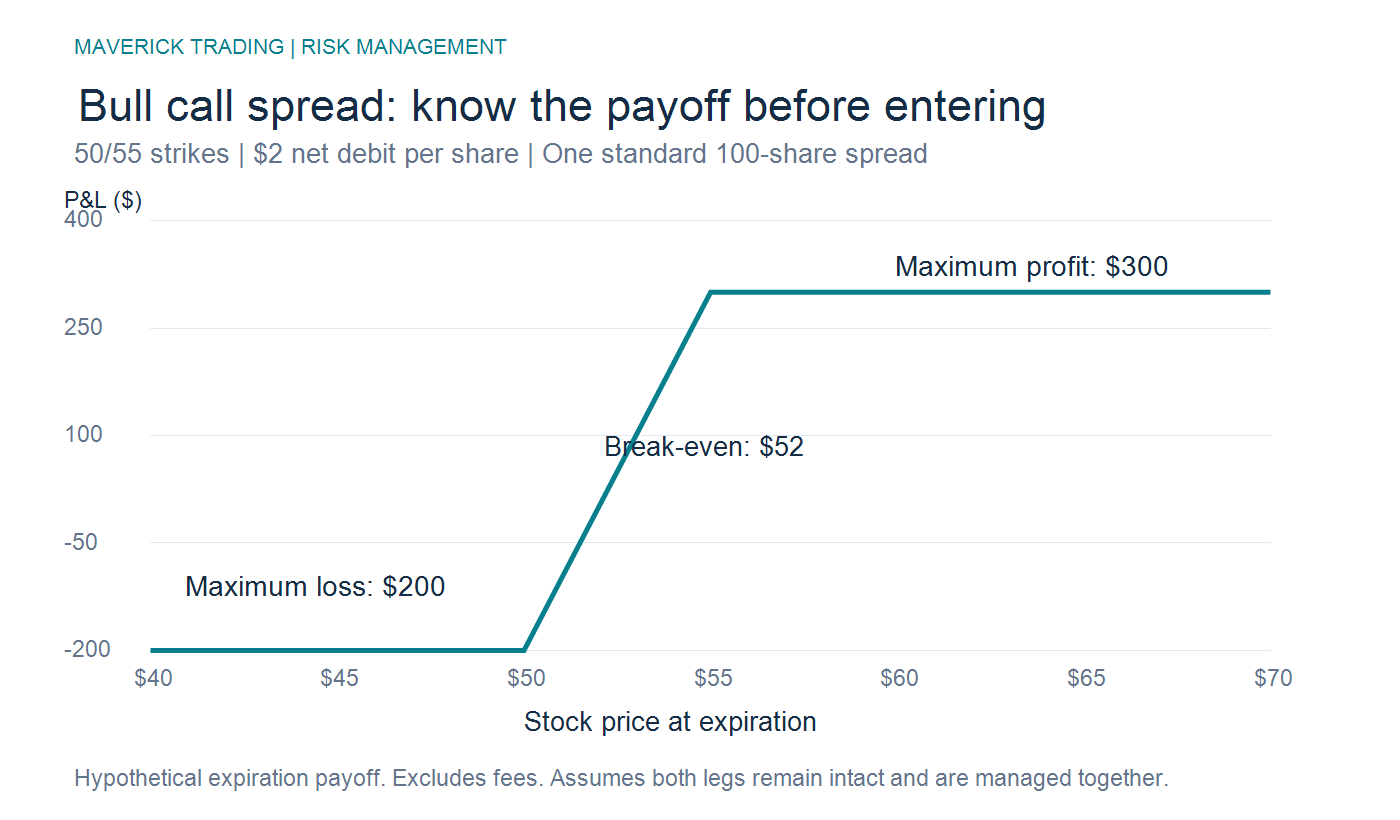
Hypothetical expiration payoff, before fees. The spread must remain intact and its assignment and expiration handled together.
If the stock drops sharply and later recovers, the spread can still become profitable if the recovery happens before expiration. But the timing matters: a rebound after the options expire won’t help. Short-option assignment and expiration also need to be managed. Fidelity explains the bull call spread’s payoff and risks.
Here’s why I like this approach: I can size the position around the maximum loss instead of depending entirely on a tight stock stop to control my risk.
That doesn’t mean I ignore the trade. It means I’ve decided how much I’m willing to lose before the market starts moving around.
And don’t confuse “defined risk” with “small risk.” If you buy too many spreads, you can still lose too much money. The number of contracts has to fit your account and your risk limits.
2. Start smaller, give the trade room, and add only when it works
If you’re going to use stops, position sizing becomes especially important.
Let’s say you normally buy 1,000 shares and use a stop $1 below your entry. Your planned risk is $1,000.
Now suppose the stock’s normal swings have become much larger. That same $1 stop might sit right inside the movement you should expect.
One adjustment is to buy fewer shares and use a wider stop:
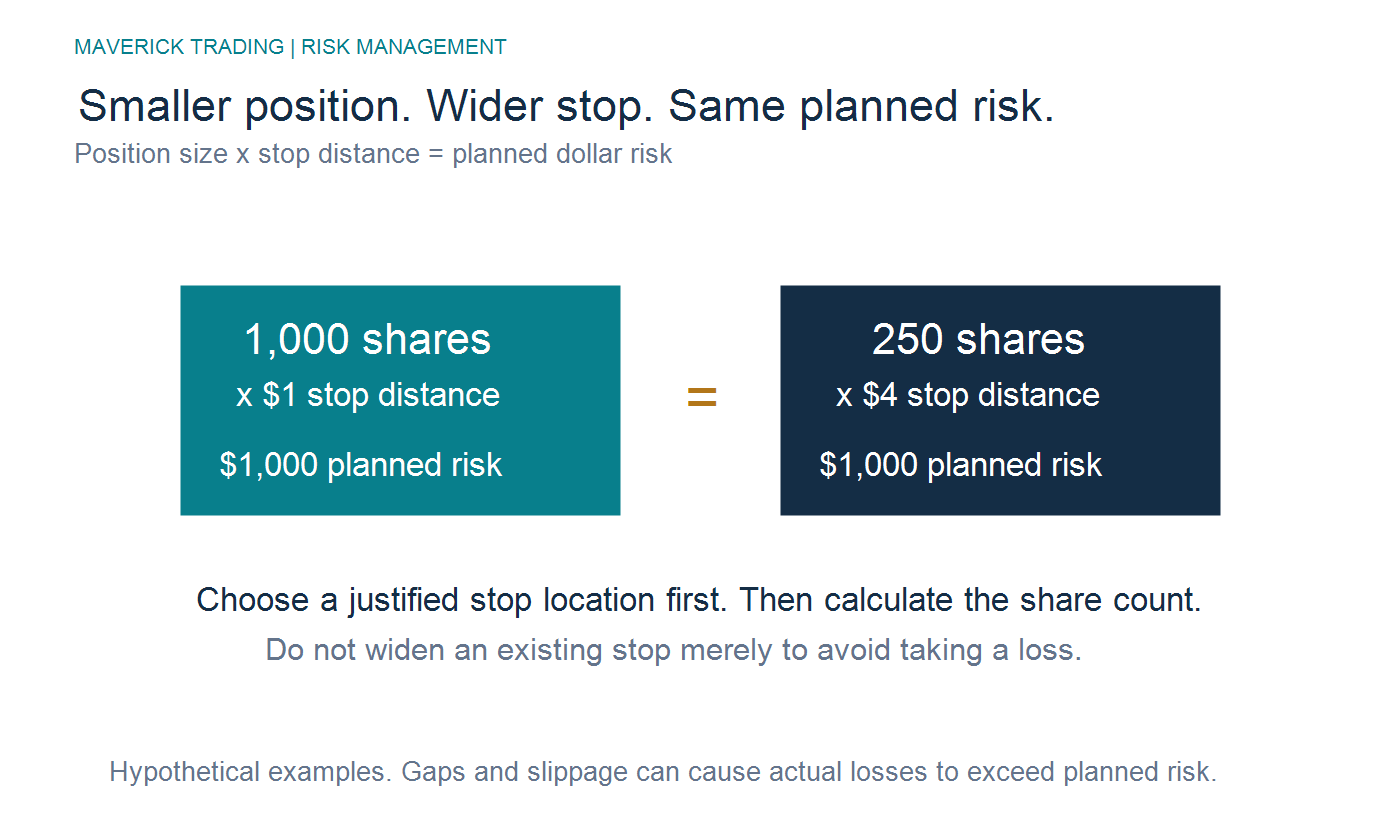
Reducing the share count allows a wider stop distance at the same planned dollar risk. Actual losses may be larger.
You’ve given the position more room without increasing the planned dollar risk.
The important word is planned. A stop price does not guarantee your execution price. A gap or fast market can produce a larger loss. The SEC explains this distinction in its guide to order types.
You also need a reason for the stop location. Don’t just move it farther away because you don’t want to take a loss. Choose a level that fits the trade, then calculate the position size.
Once you have that smaller position, let the trade develop.
If it moves against you but remains within your original plan, you don’t automatically buy more. If it reaches your exit condition, you get out. You don’t keep widening the stop.
If it starts working, that’s when you can consider adding.
My rule for pyramiding: add to winners
Pyramiding means building the position as the trade moves in your favor.
You might start with 250 shares, add another 250 after a favorable move, and adjust the stop as the position develops.
But you have to recalculate the risk across the entire position. More shares and a new average entry price change the math. Adding to a winner doesn’t automatically make the larger position safe.
My rule is simple: don’t add until the trade is profitable.
I know the temptation. You buy at $50, it drops to $40, and you think buying more will give you a better cost basis.
It will lower your average entry. It will also increase your exposure to a trade that is moving against you.
For this strategy, I want the market to start confirming the trade before I commit more money.
3. Use a collar to protect stock you already own
A collar is another way to define risk, particularly when you already own shares and want protection through a volatile period.
You hold the stock, buy a protective put, and sell a covered call. The call premium helps offset the put’s cost, while the call also limits your upside.
Let’s say your stock is trading at $70. You could buy a $60 put and sell an $80 call with the same expiration, covering the same number of shares.
The put establishes a floor for the protected shares while it remains in force. The call caps the upside. Your actual profit and loss also depend on your stock cost basis, the net option premium, and fees. Fidelity’s collar guide explains this trade-off.
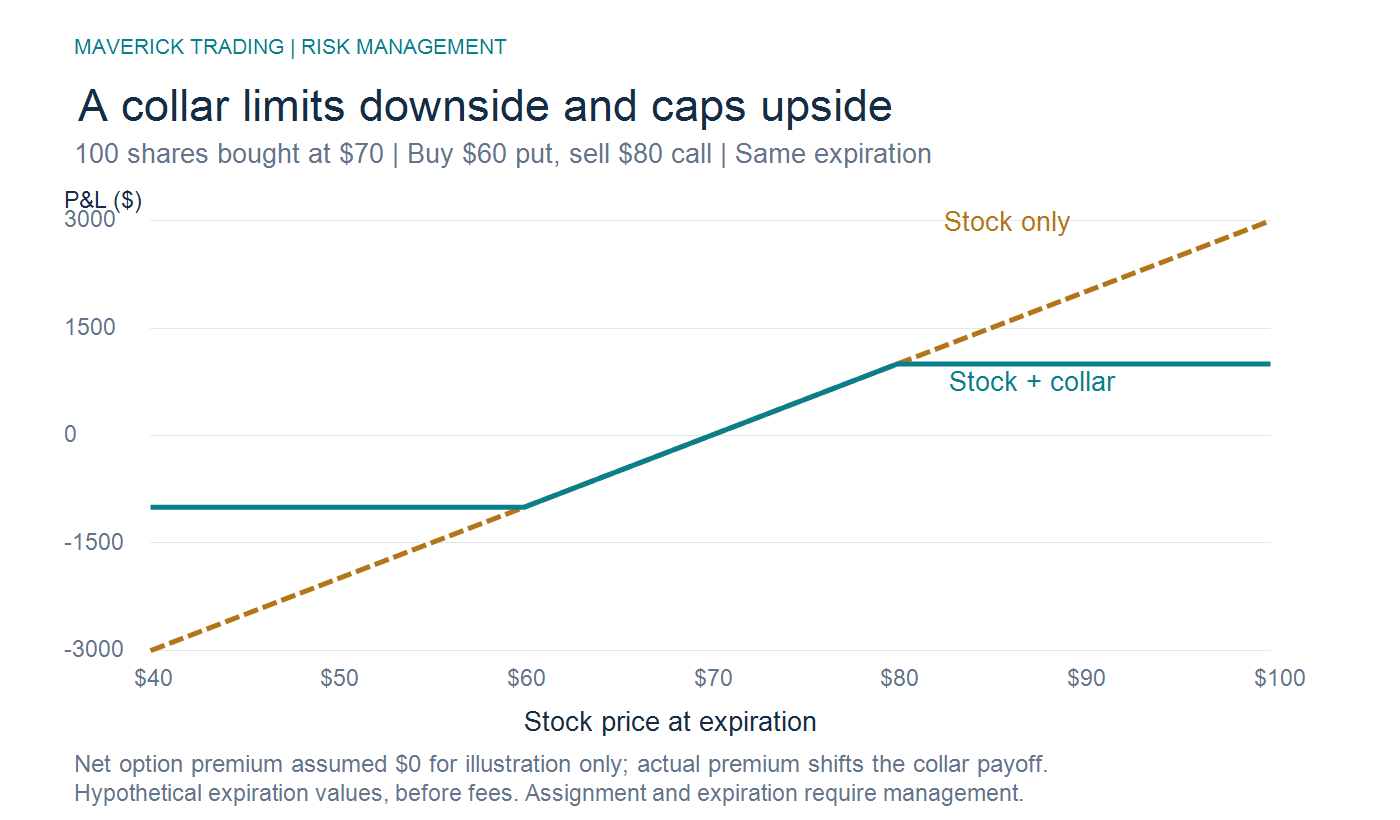
For this illustration only, stock was purchased at $70 and net option premium is assumed to be zero. A real debit or credit shifts the payoff. This does not assume the put and call have equal prices.
That can be useful when you’re willing to give up some potential upside in exchange for protection.
But a collar doesn’t make the position disappear. The put and call won’t necessarily cost the same amount, and you can still have gains or losses. The short call can also be assigned, meaning you may have to sell your shares.
Before putting it on, decide whether you’re comfortable selling at the call strike and what you’ll do as expiration approaches.
Don’t assume volatility will be gone by then. Reassess the market when you get there.

Stock photography by tonodiaz / Envato. Illustrative trading workspace.
You can also sit out
You don’t have to trade every market.
At Maverick, some traders use a rule such as staying out when the VIX is above 20. Their strategies are designed for quieter conditions, so they step aside when those conditions change.
That’s an example of a trading rule, not a universal cutoff.
The VIX measures expected S&P 500 volatility over roughly the next 30 days. It doesn’t predict market direction, and it doesn’t tell you exactly how an individual stock will behave. Cboe explains what the VIX measures.
The useful part is having a rule that fits your strategy and following it.
Knowing how you react under pressure matters, too. Our Trader Personality Test can help you reflect on your trading tendencies; it is not a prediction of trading success.
If your trading results suffer consistently in high volatility, sitting out can be a deliberate risk decision. You can wait for conditions that better suit your approach.
High volatility trading strategies: your pre-trade checklist
Use a pre-trade checklist to make these decisions before you enter. When you’re deciding how to trade volatile markets, ask yourself:
- Does this setup still fit the current environment?
- Have I sized the position for the wider price swings?
- Am I relying on a stop, or have I defined risk through the trade structure?
- If I add, will the total position remain within my risk limit?
- Would sitting out be a better decision?
You can be wrong about a trade in any market. Higher volatility doesn’t excuse a bad entry or poor risk management.
But when the environment changes, your approach needs to account for it. Consider defined-risk spreads. Start smaller if you need a wider stop. Add only when the trade is working. Use a collar when protecting an existing stock position makes sense.
And if your strategy doesn’t fit the market in front of you, you don’t have to force it.
Protecting your ability to trade tomorrow is part of the job today.
Interested in developing a more disciplined trading process? Learn about applying to Maverick Trading.
If your focus is forex rather than stocks and options, explore our sister firm, Maverick Currencies. The stock-option examples above do not transfer directly to spot forex.
Examples are hypothetical and provided for education. Options involve risk, and fees affect results.