
Why Most Traders Misread Market Signals
If you've ever stared at a chart convinced a breakout was about to run, only to watch it stall and reverse, you already know how costly misread market signals trading can be. The frustrating part is that the signal probably wasn't missing. You likely saw it. You just interpreted it through the wrong lens.
Most traders don't lose money because information isn't there. They lose money because they filter that information through confirmation bias, personal bias, or plain old market noise, and then act as if what they're seeing is a fact rather than an interpretation.
That distinction matters more than it sounds. A chart doesn't hand you a verdict. It hands you data, and your job is to interpret that data as objectively as you can. The moment personal bias, timing errors, or random noise creep into that interpretation, you're no longer reading the market.
"You're reading your own expectations back at yourself, and the market has a way of making that an expensive habit."
Confirmation Bias Is the Real Culprit
Here's a pattern that shows up constantly: a trader finds a stock they already like, then goes hunting for reasons to justify the trade. They pull up the chart, check the fundamentals, and look for anything that supports the idea they've already committed to in their head. Rarely do they ask the opposite question, which is what would disqualify this trade.
That one shift, actively looking for reasons not to take a trade, is one of the simplest ways to catch a bad setup before it costs you money. Skilled traders treat disqualification as part of their process, not as second guessing themselves. If you want to go deeper on why this happens in the first place, Understanding Market Psychology breaks down the psychological patterns most traders never notice they're falling into.
The Market Is Loud, and Some of That Noise Is Intentional
Add to this the sheer volume of noise hitting traders every day: news headlines, analyst calls, earnings commentary. Not all of it is neutral. Some of it exists specifically to shape public perception, and it's been used plenty of times to nudge retail traders into doing the wrong thing at exactly the right time for someone else. Learning to separate real trend information from manufactured noise is a skill on its own, and it takes deliberate practice to build.
This is where a lot of traders get stuck emotionally, too. When the noise is loud enough, it tends to produce one of two reactions: either waiting too long to get into a trade because nothing ever feels certain enough, or chasing a move well after it's already extended. Neither reaction comes from a lack of effort. Both come from trying to process too many inputs at once without a clear filter for what actually matters.
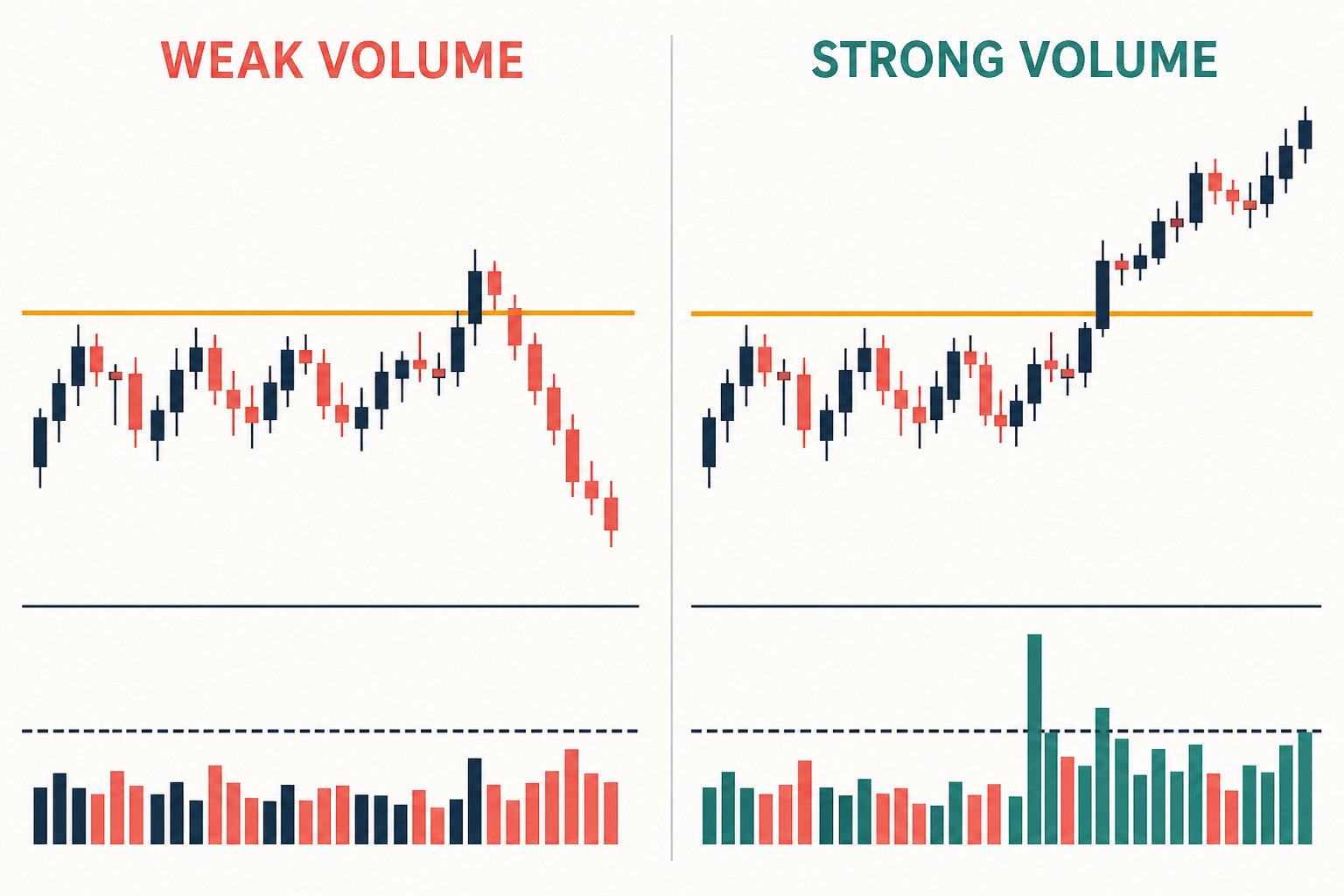
An illustrative comparison: a breakout with weak volume behind it versus one confirmed by strong volume.
False Breakouts: The Classic Way Traders Misread Market Signals
One of the most common ways this plays out is the false breakout. A stock breaks above a base, momentum looks strong, and it feels like the move is just getting started. Without volume confirmation though, that breakout can just as easily be a trap.
Picture two nearly identical setups. In one, a stock breaks out of a base on volume that's well above average, and the move holds and keeps climbing. In the other, the same pattern breaks out on volume that's below average, right near an all time high, and the traders who buy in get caught just before the price drops. The chart pattern alone told almost the same story in both cases. Volume was the piece that separated a real move from a trap.
Indicator Overload Creates Its Own Kind of Noise
There's an ironic problem in trading education. The more indicators traders stack on a chart, thinking they're getting more information, the less clear the picture actually becomes. MACD, Bollinger Bands, RSI, and multiple moving averages all layered together often lead to analysis paralysis rather than clarity. Signals stop lining up, or they all line up at once, and traders end up chasing price after the move has already happened.
"The fix isn't more indicators. It's fewer, chosen deliberately."
The fix isn't more indicators. It's fewer, chosen deliberately. Pick one or two that complement each other, maybe one leading and one lagging, and clear the rest off the chart. Price action is still the most important thing you're tracking. Everything else should support that, not bury it.
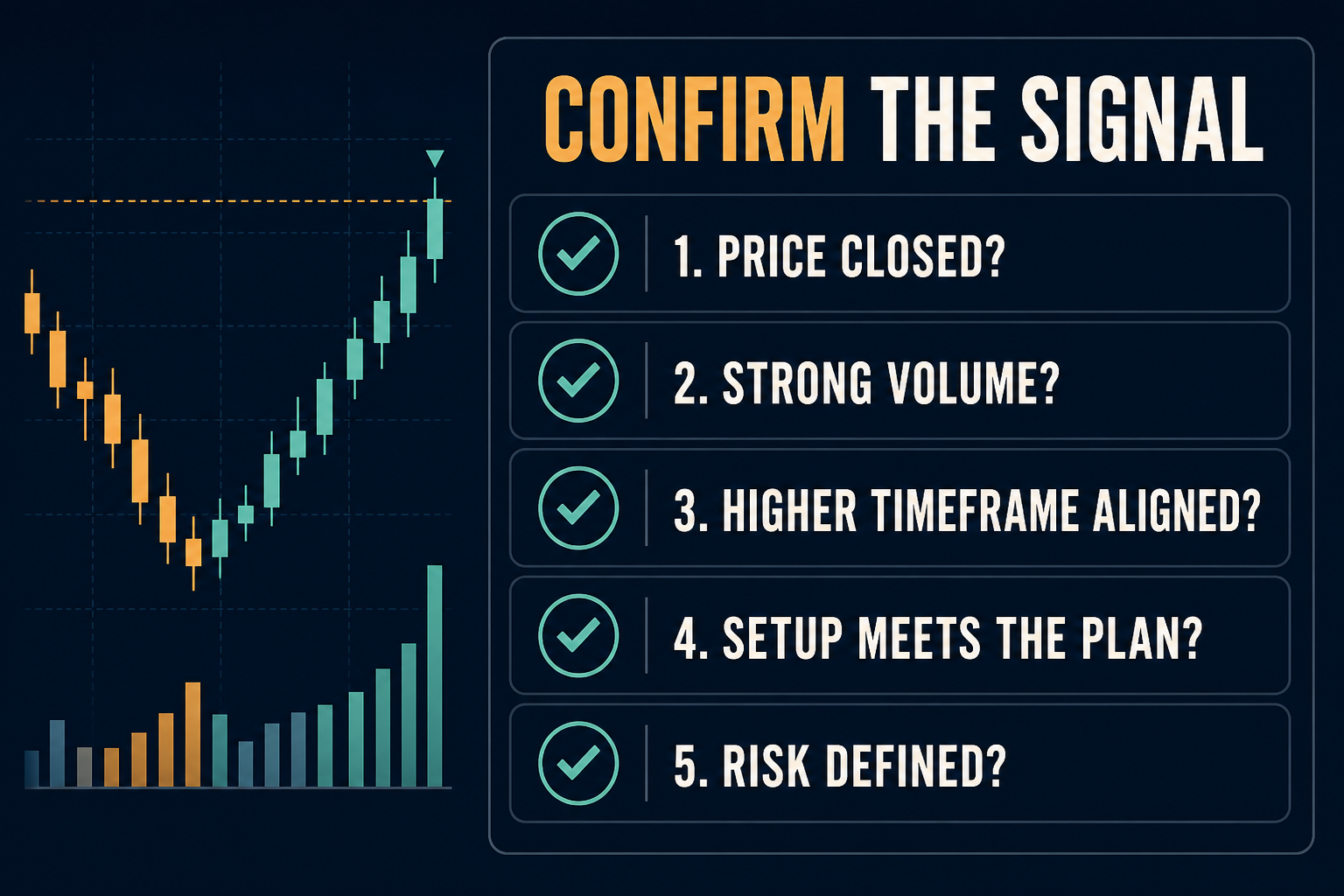
A quick confirmation check to run before trusting any signal.
How Professional Traders Approach This Differently
Professional traders don't avoid these traps because they have access to secret information. They avoid them because their process is built around confirmation and structure instead of gut feel.
That means waiting for price to close on strong volume before trusting a move. It also means checking more than one timeframe. A day trader working off a five minute chart who never glances at the daily or weekly chart is missing the context for where price actually sits inside the bigger trend. A swing trader should do the same thing in reverse, checking the weekly chart for trend and using a shorter timeframe to time the entry. Neither view alone tells the full story.
It also means having a written trading plan with rules that define exactly what qualifies a setup and what doesn't, so a good feeling never overrides the plan. Process matters more than any single outcome here. A trader who consistently follows their own rules will take losing trades from time to time, and that's fine, because the setups still met their criteria. What separates a disciplined trader from an undisciplined one isn't the win rate. It's whether they can look back at a trade and honestly say they followed their own plan.
Structure and Risk Management Matter Too
This is also where structure at a firm level matters. Trading inside an organized environment, with mentorship, defined risk parameters, and daily accountability, tends to produce very different outcomes than trading alone with no framework. If you're curious what that structure actually looks like in practice, What Is Proprietary Trading is a good place to start.
Risk management is the other half of the equation. Reading signals correctly still won't protect you if position sizing or stop placement is off. How Professional Traders Think About Risk walks through how experienced traders size positions and cap downside before they ever place a trade, not after.
What to Do With This
If you want a practical next step, go back through your last five to ten trades. For each one, ask what the market was actually showing you at the time, not what you wanted it to show you. Look for patterns: entering too early, confusing momentum with confirmation, ignoring the higher timeframe, or forcing a setup that didn't really meet your own rules.
That last one is worth sitting with. It's not uncommon for a trader to look back at a losing trade and admit the setup didn't meet their own criteria, and they took it anyway. That's not a signal problem. That's a discipline problem, and it's fixable once you can see it clearly.
"Misreading signals isn't a sign that you're bad at trading."
Misreading signals isn't a sign that you're bad at trading. It's usually a sign that bias, noise, or an overloaded chart got in the way of the one thing that actually matters, which is price. This is where trading within a structured environment can start to make a difference over time.